

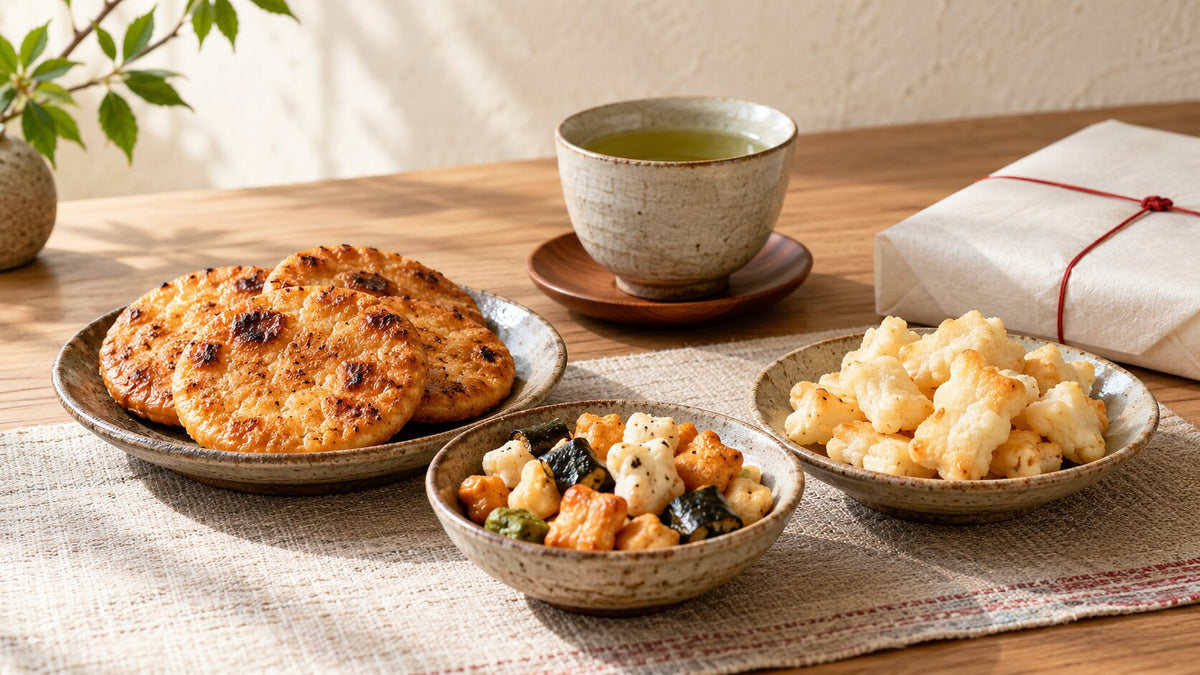
Japanese rice crackers range from broad, firmly grilled senbei to small arare and irregular pieces of okaki. The names can overlap in everyday shopping, but rice type, size, preparation, and seasoning give each style a different texture.
For gift buyers, the useful questions are practical: How hard is the cracker? Which flavors does the recipient enjoy? Are the ingredients clearly labeled? Will the package stay crisp during delivery? This guide explains what to look for without treating every rice-based snack as interchangeable.
Senbei, arare, and okaki at a glance
| Style | Common rice base | Typical form | Useful gifting clue |
|---|---|---|---|
| Senbei | Usually non-glutinous rice | Often flat, round, and firmly crisp | Good for someone who enjoys a substantial toasted crunch |
| Arare | Usually glutinous rice | Small, bite-sized pieces | Easy to sample and share in a mixed assortment |
| Okaki | Usually glutinous rice | Larger or irregular pieces | Offers a varied, sometimes airier or chunkier texture |
These are useful guides rather than absolute visual rules. Modern makers use different shapes and techniques, so the current product description and package remain the best reference.
“Glutinous rice” means sticky rice; it does not mean the rice itself contains gluten. A finished cracker can still contain wheat through soy sauce, seasoning, or other ingredients.
How rice and preparation shape the texture
Senbei is commonly made from non-glutinous rice that is cooked, formed, dried, and then grilled or baked. Drying prepares the piece to become crisp under heat. Some crackers are brushed with seasoning during or after cooking, while others keep the toasted rice flavor more prominent.
Arare and okaki are commonly associated with mochi rice. Depending on size, drying, and heating, they may become light and expanded or keep a denser bite. Fried versions also exist, so “rice cracker” does not automatically mean baked or low in fat.
You do not need laboratory measurements to choose a gift. The most useful texture descriptions are plain ones:
- Thin and delicate: easier to break, with a lighter crunch.
- Firm and grilled: a stronger bite and more pronounced toasted flavor.
- Small and airy: convenient for tasting several seasonings.
- Irregular and substantial: a chunkier texture that suits slow snacking.
Very hard crackers may not suit every recipient. When texture is uncertain, choose a varied assortment or clearly described lighter styles.
Common flavor families
Seasoning changes the experience as much as shape. Common options include:
- Salt: keeps the toasted rice flavor at the center.
- Soy sauce: adds color, saltiness, aroma, and savory depth.
- Nori: contributes a roasted seaweed note.
- Sesame: brings a nutty aroma and surface texture.
- Chili: ranges from gentle warmth to a sharper finish.
- Sweet soy or sugar glazes: combine crispness with a sweet-savory coating.
- Seafood seasonings: may include shrimp, fish, bonito, or shellfish-derived ingredients.
A broad assortment is helpful for a first-time taster. A focused soy-sauce, seaweed, or salt selection makes more sense when you already know the recipient’s preferences.
Dietary checks matter
Rice crackers should not be assumed to be gluten-free, vegan, vegetarian, halal, kosher, or suitable for an allergy simply because rice is the main ingredient.
Review each product for ingredients relevant to the recipient, including:
- Wheat in soy sauce or other seasoning blends.
- Soy and sesame.
- Shrimp, crab, fish, bonito, and other seafood ingredients.
- Milk or egg in flavored coatings.
- Peanuts and tree nuts.
- Cross-contact or shared-facility statements.
Japanese labels may identify ingredients such as 小麦 (wheat), 大豆 (soybean), ごま (sesame), えび (shrimp), かに (crab), 乳 (milk), and 卵 (egg). A short translation key can help, but it should not turn unclear or missing information into a safety promise.
For a serious allergy or strict diet, use the current manufacturer packaging as the primary source and let the recipient review it before eating.
How to choose rice crackers as a gift
| Recipient | Useful direction | What to verify |
|---|---|---|
| First-time taster | Mixed senbei, arare, and okaki | Clear flavor labels and manageable spice levels |
| Tea enthusiast | Simple salt, soy, sesame, or nori styles | Texture and preferred tea pairing |
| Office or family | Individually wrapped portions | Quantity, allergens, and easy identification |
| Adventurous eater | Regional or stronger seasonings | Seafood ingredients, chili, and unfamiliar flavors |
| Recipient with dietary needs | Clearly labeled, narrowly selected products | Ingredients and cross-contact information item by item |
Choose contrast deliberately. A small assortment with one firm soy-sauce senbei, one light salt style, and one bite-sized arare mix can be more informative than a large box of nearly identical crackers.
Do not promise gift wrapping, a message card, or a fixed assortment unless the current listing includes those details. Product contents and packaging can change.
Serving and pairing
Green tea is a natural partner for toasted rice, salt, soy sauce, sesame, and nori. Stronger savory crackers can also work with beer or sake for an adult recipient, while mild tea or a non-alcoholic drink keeps the tasting simple.
Arrange a few different pieces on a small plate and keep the original packaging nearby. That lets guests compare seasonings and check ingredients. Large or firm crackers can be broken into manageable pieces rather than bitten whole.
For more help planning a mixed tasting gift, see the Japanese snack gift-box guide and the Japanese snack box guide.
Keeping rice crackers crisp
Moisture quickly changes a cracker’s texture. Keep unopened packages in a cool, dry place and follow the storage directions on the label. After opening, reseal the package promptly or move the remaining crackers to an airtight container.
- Open only what will be served.
- Keep delicate and strongly seasoned varieties separate where practical.
- Check packages for damage before gifting or eating.
- Do not use a reheating method unless the product instructions support it.
- For international gifts, compare the product dates and storage needs with the expected delivery window.
Current shipping options, destination eligibility, and customs responsibilities should be checked before ordering. The international shipping terms guide explains common delivery language.
Catalog note
Gift Me Japan’s rice-cracker products are not currently active in the live catalog, so this guide does not recommend or illustrate a specific listing. That avoids sending readers to unavailable products or presenting Draft items as purchasable. Check the live store for future availability and confirm each listing’s current contents before ordering.
Final takeaway
Start with the recipient’s preferred texture and flavor, then verify ingredients, packaging, dates, and shipping conditions. Choose senbei for a firmer toasted bite, arare for small shareable pieces, or okaki for a larger glutinous-rice style—while remembering that individual products vary.
A thoughtful rice-cracker gift does not need an elaborate history lesson. Clear labels, a balanced assortment, and attention to the recipient will do more to make it enjoyable.

Share:
Best Japanese Snack Gift Boxes: A Practical Buyer’s Guide
Best Japanese Snacks to Give as Gifts: A Practical Guide