

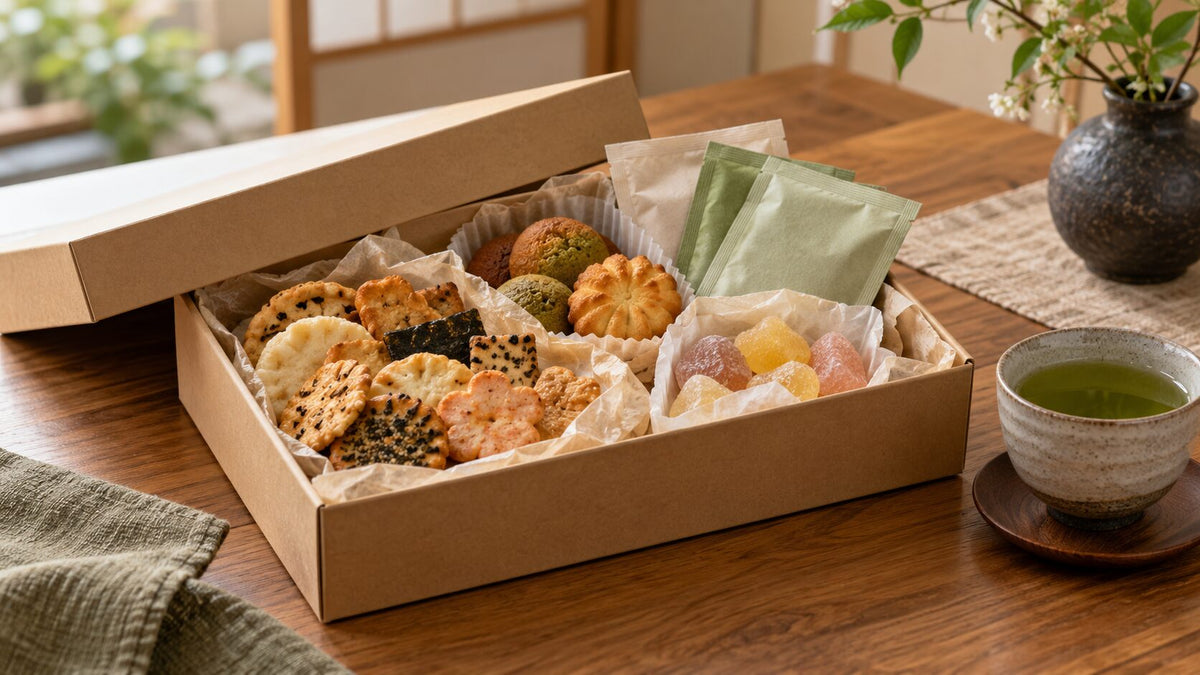
A sweet and savory Japanese snack box works best when it feels like a tasting experience, not a pile of individually wrapped treats. The contrast is the point: crisp rice crackers beside soft sweets, salty or umami seasoning followed by fruit, chocolate, or a light baked snack.
Whether you are buying a ready-made assortment or building one yourself, focus on balance, clear labeling, and how well the contents suit the recipient. A smaller box with distinct flavors is often more enjoyable than a large box filled with near-duplicates.
What to Include in a Sweet and Savory Japanese Snack Box
Start with two or three savory styles and two or three sweet styles. This gives the recipient enough variety without making the box feel unfocused.
Build a savory foundation
Senbei and arare are natural anchors. Senbei are Japanese rice crackers that range from thin and crisp to thick and hearty; arare are generally smaller, bite-sized rice snacks. Seasonings may include soy sauce, seaweed, sesame, salt, or mild spice.
Choose savory items that differ from one another. A soy-seasoned cracker and a seaweed-flavored bite provide more contrast than several versions of the same salty snack. If the recipient is new to Japanese flavors, begin with approachable seasonings before adding stronger seafood, wasabi, or fermented notes.
Add sweets with different textures
For the sweet side, look beyond sugar level. A good mix might combine a crisp wafer, a soft mochi-style confection, a baked cake or biscuit, and a fruit jelly. Traditional wagashi can add seasonal character, while familiar chocolate or cookies offer an easy starting point.
Heat and shelf life matter. Chocolate can be a poor choice for a warm route, while fresh or delicate wagashi may have a shorter best-before period than packaged crackers. Always use the current product label for storage instructions.
How to Balance the Box
A simple approach is to alternate flavors and textures:
- Salty and mild: a lightly salted rice cracker with a soft sweet.
- Umami and rich: a soy- or seaweed-seasoned snack with chocolate or a baked biscuit.
- Crisp and chewy: senbei beside a mochi-style confection or fruit jelly.
- Familiar and exploratory: one recognizable sweet alongside a regional or seasonal specialty.
There is no perfect ratio, but an even split is a useful starting point. Adjust it for the recipient: someone with a sweet tooth may prefer more confectionery, while a person who enjoys tea or drinks may appreciate a stronger savory side.
Choose for the Recipient, Not the Item Count
For one person, a compact assortment with six to ten distinct items is usually easier to enjoy than a box of many repeated packets. For a family or office, individually wrapped pieces are practical for sharing, but the box should still provide clear ingredient and allergen information.
Think about the occasion as well. A host gift can be modest and easy to open together. A birthday box can include a few more adventurous flavors. For a care package, choose sturdy products with generous shelf life and avoid items that require refrigeration.
If you are assembling the gift yourself, include a short contents card with the snack names, flavor notes, and suggested tasting order. Keep all original packages so the recipient can refer to the official ingredient and date information.
Allergens and Dietary Needs
Mixed snack boxes require item-by-item checking. Common ingredients can include wheat, soy, milk, egg, peanuts, tree nuts, sesame, seafood, gelatin, and buckwheat. A sealed packet is not automatically suitable for someone with an allergy, and a product name or front-of-pack image is not enough to confirm whether it is vegan, vegetarian, halal, kosher, or gluten-free.
For a serious allergy, check the complete current label, advisory statements, and any information about shared production facilities. If the seller cannot provide enough detail, choose a different gift. The original packaging should travel with every item.
How to Judge Value and Quality
Packet count can be misleading. Compare the number of genuinely different snacks, the stated weight or portion details, best-before information, and the overall range of flavors. A well-chosen regional sweet may add more interest than several extra versions of the same cracker.
| Check | Why it matters |
|---|---|
| Distinct items | Shows whether the assortment offers real variety. |
| Ingredients and allergens | Helps you judge suitability before ordering. |
| Best-before dates | Important for international delivery and delayed opening. |
| Storage guidance | Protects crisp snacks and heat-sensitive sweets. |
| Shipping cost and timing | Determines the true price and whether the gift can arrive when needed. |
Packing and International Shipping
Keep food in its original sealed packaging and protect crisp items from crushing and humidity. Do not assume that every destination treats packaged food in the same way: import restrictions and customs procedures vary by country.
Before ordering, review Gift Me Japan's current shipping policy and the destination's official import guidance. Allow extra time around holidays, and avoid choosing heat-sensitive products when the route or season makes temperature damage likely.
A Simple Formula for a Thoughtful Box
Choose two contrasting rice snacks, two sweets with different textures, one seasonal or regional item, and an optional tea or coffee pairing. Then check every label, confirm the delivery conditions, and add a personal note.
For more background on the savory side, see our guide to traditional Japanese rice crackers. You can also compare the selection process in Best Japanese Snacks to Give as Gifts.
The best sweet and savory Japanese snack box is not necessarily the biggest. It is the one whose flavors, textures, labeling, and presentation make sense for the person receiving it.
Share:
Best Japanese Snacks to Give as Gifts: A Practical Guide
Individually Wrapped Japanese Snacks: A Practical Guide