


Does buying a Japanese eyelash serum tell you what it will do, or only where it's sold? A conditioning formula and a drug-like growth formula can look remarkably similar on a shopping page, yet they call for different expectations and precautions.
For international gift shoppers, that distinction matters more than elegant packaging or a promise of longer-looking lashes. Understanding the ingredients, checking the label and knowing when to stop will help you decide whether lash care belongs in the recipient's routine at all.
What Japanese Eyelash Serums Contain and How They Differ
A Japanese eyelash serum is generally a leave-on cosmetic liquid sold in Japan and applied along the upper lash line, although some products direct application onto the lashes themselves. Serum describes the format, not the active ingredients or regulatory category. A product sold from Japan also isn't necessarily manufactured there.
Think of the difference between a hair conditioner and a prescription hair-loss treatment. Both belong to hair care, but they don't work in the same way or carry the same risks.
The distinction that matters most
Prostaglandin analogues are the drug-like group. They shouldn't be treated as interchangeable with ordinary lash conditioners, even when the packaging looks cosmetic.
Non-prostaglandin conditioners typically use ingredients such as peptides, growth factors, pumpkin-seed oil, ginseng or other botanical extracts. Their presence doesn't establish that the finished product produces biological lash growth. Supporting the appearance or condition of existing lashes is a different claim.
Japanese eyelash serum ingredient groups at a glance
| Ingredient group | Examples named in research | Evidence picture | What to check on the label |
|---|---|---|---|
| Prostaglandin analogues | Bimatoprost, FDA-approved for eyelash growth; latanoprost; fluprostenol; dechloro ethylcloprostenolamide; isopropyl cloprostenate | Bimatoprost has the most clinical data; the other named molecules have not been adequately assessed for cosmetic use, according to the 2024 Journal of Cosmetic Dermatology review. | Treat these as drug-like ingredients and look for their names in the complete ingredient list. |
| Non-prostaglandin conditioners | Peptides; growth factors; pumpkin-seed oil; ginseng; botanical extracts | Many have limited formal evidence, although some appearance studies exist. | Look for substantiated claims about curl, thickness, luster or volume rather than assuming proven growth. |
Don't classify a formula by its headline ingredient
A front label highlighting peptides doesn't tell you what else the formula contains. Read the entire list, including ingredients printed after the featured botanical or conditioning complex.
Likewise, natural doesn't mean suitable for every eye area, and Japanese doesn't describe a safety category. Broader advice on choosing Japanese skincare products can help with routine planning, but lash products need particular care because of where they're applied.
Practical rule: You should be able to identify a serum's ingredient group before choosing it. If the label or translation leaves you unsure, pause the purchase rather than guessing.
What Studies Show and What They Do Not Prove
The useful question isn't whether eyelash serums work. It's which formula was tested, how it was tested and what the investigators measured.
A controlled drug trial can compare an active ingredient with its vehicle, meaning the base formula without that active. An open-label cosmetic study, where participants know what they're using, can document changes but leaves more room for expectations to influence assessments.
Different studies answer different questions
The bimatoprost benchmark concerns a specific pharmaceutical formulation, not every product marketed as lash serum. Its assessment scale also matters: a study's definition of success isn't the same as a guarantee that every participant will notice a dramatic transformation.
The smaller polygrowth-factor study concerns appearance measures in a particular group. Its percentages shouldn't become promises on an unrelated Japanese product page.
Key figures from the studies reviewed
| Study | Design and size | Reported result |
|---|---|---|
| Bimatoprost benchmark | The FDA-reviewed trial was multicenter, double-masked, randomized and vehicle-controlled; 278 adults applied 0.03% bimatoprost for 16 weeks. | Success was assessed as at least a one-grade improvement on the four-point Global Eyelash Assessment scale; effects were generally not statistically apparent for most users until approximately two months. |
| Polygrowth-factor serum | The Journal of Cosmetic Dermatology review describes a 90-day open-label study in which 29 women completed treatment. | Reported appearance improvements were curl 50.83%, thickness 35%, luster 11.43%, length 10.52% and volume 9.3%. |
| Prostaglandin-based products after stopping | Wider review of published evidence. | Gains can diminish approximately 4–6 months after treatment stops, as described in the clinical evidence summary. |
Appearance improvements aren't interchangeable with growth
A lash can look fuller because it's better conditioned or less prone to breakage. That doesn't establish that a product has changed follicular growth, and an impressive curl measurement doesn't mean an equally large increase in length.
The open-label results are useful as preliminary evidence, not a reliable forecast for another formula or recipient. They also don't justify describing cosmetic changes as permanent.
After a month of consistent use, a realistic expectation is to assess tolerability and perhaps notice modest conditioning or appearance changes. No visible difference is also possible; applying more isn't a sensible response.
Reading Japanese Labels and Verifying Authenticity
Japanese writing and attractive packaging don't prove authenticity. A genuine-looking container can still leave you without a traceable manufacturer, readable ingredients or usable instructions.
Counterfeit cosmetics are a purchasing risk, but authenticity and suitability are separate questions. Even a genuine serum may contain something the recipient shouldn't use.
Check identity before marketing claims
Start with the manufacturer's name and address. Then identify the responsible importer or distributor where applicable in the destination country, rather than relying only on the marketplace seller's display name.
Next, obtain the complete ingredient list for the exact variant you're buying. A photograph showing only the front of the carton isn't enough, and a translated promotional description isn't a substitute for the label.
Use this purchase checklist in order:
- Manufacturer details: Look for an identifiable company and address on the product or outer packaging.
- Importer or distributor: Check who is responsible for the product locally, where applicable.
- Full ingredients: Request a readable photograph and a reliable translation, not just highlighted ingredients.
- Batch or lot code: Keep the code with your order details so the product can be traced.
- Identifiable seller: Check that the business provides clear contact and order information.
Understand Japanese-market information
Our products are manufactured for the Japanese market and sold in accordance with applicable Japanese standards. Formulations, permitted ingredients, usage instructions and labelling requirements may differ between Japan and your country, so don't assume that claims or classifications transfer unchanged.
Japanese cosmetics often use a production or batch code instead of printing an expiry date. Look for that code and any period-after-opening symbol, which indicates a suggested use period after opening; don't assume an absent printed expiry means unlimited shelf life.
At Gift Me Japan, we sell genuine products sourced in Japan through established suppliers and distribution channels, and ship directly from Japan. Our guide to buying authentic Japanese gifts online offers broader purchasing checks for international shoppers.
A traceable seller and a complete label help establish what you're buying. Neither proves that a serum will produce the result you want.
If the packaging and translated listing disagree, resolve the discrepancy before giving the product. A recipient shouldn't have to investigate an unfamiliar eye-area formula after unwrapping it.
How to Apply a Japanese Eyelash Serum Step by Step
Use a serum only on the area specified by its instructions. The routine below describes a lash-line product; a brush-through conditioner may have a different application method.
This illustration provides a visual orientation, but the product's translated directions take priority.
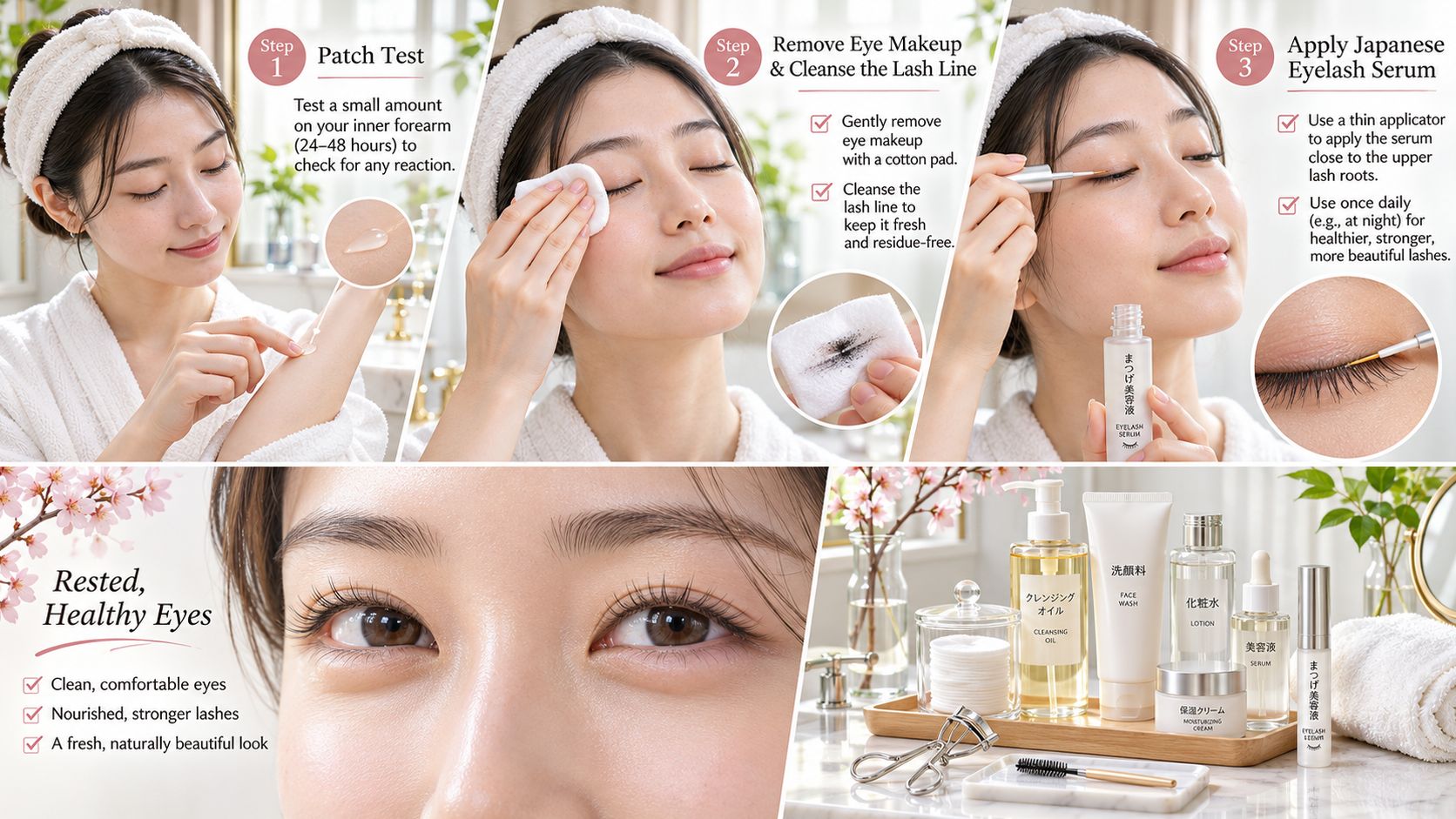
Prepare, apply and record
- Patch test first. If compatible with the product's directions, apply a small amount to the inner forearm and wait 24 hours before first use. This may reveal a skin reaction, but passing it doesn't establish eye safety; don't mistake it for permission to ignore symptoms later.
- Remove makeup and cleanse the lash line. Gently clear away mascara, eyeliner and oily residue, then let the area dry. A common slip is applying serum over makeup, where it can mix with residue instead of reaching the intended area.
- Wash and dry your hands. Use the supplied clean brush, or a fresh disposable applicator if that's what the instructions require. Don't share the applicator or substitute an old mascara wand.
- Apply a thin line where directed. For an upper-lash-line formula, stay close to the lash base while avoiding the waterline, the moist inner rim of the eyelid, and the eye itself. Don't add lower-lash application unless the label explicitly instructs it.
- Blot away excess. Use a clean tissue to remove liquid that spreads beyond the intended area. A wet stripe isn't evidence of a better dose and can run into the eye.
- Keep to the labelled frequency. More frequent application isn't a safe shortcut and may increase irritation. Don't double an application to make up for one you missed.
- Keep a dated log. Note application, discomfort and visible changes, and take a photograph in the same light each week. Avoid mascara, filters and different camera angles when comparing pictures.
For a second visual explanation, watch the application demonstration while keeping your own product's directions beside you.
Keep the surrounding routine simple
Avoid introducing several unfamiliar eye-area products together, since that makes a reaction harder to trace. A straightforward Japanese skincare routine for beginners can help you organise cleansing and moisturising without crowding the lash line.
Cosmetic changes develop over weeks, not immediately after application. Check Japanese-language instructions against a reliable translation before use, including warnings, storage and applicator care.
Side Effects to Watch For and When to Stop
Stop using a serum when an unexpected eye-area reaction develops. Don't keep applying it while waiting to see whether improved lashes make the discomfort worthwhile.
Prostaglandin-based formulas can affect more than lash appearance. The Royal Australian and New Zealand College of Ophthalmologists position statement describes irritation, pigmentation changes, unwanted hair growth and prostaglandin-associated periorbitopathy, including fat loss that can create a sunken appearance around the eye.
Match the reaction to the action
The table moves from surface discomfort to structural or pigment changes that need particular attention. It's a decision aid, not a diagnosis or a ranking of how frequently each reaction occurs.
Reactions to a Japanese eyelash serum and the first action
| Reaction | First action | Seek professional care when |
|---|---|---|
| Redness or itching that persists | Stop use and rinse the area with water. | Symptoms don't settle after stopping. |
| Eye irritation, watering or dryness | Stop use and keep the product away from the eye. | Symptoms continue or worsen. |
| Darkening of the eyelid skin | Stop use and record the change with a photo. | Any change persists or spreads. |
| Excess hair outside the lash line | Stop use and wash the area gently. | Growth continues after stopping. |
| Sunken or hollow look around the eye | Stop use. | You notice this at any stage of use. |
| Any change in iris colour | Stop use. | Book an eye examination promptly, since iris darkening has been reported with prostaglandin-based products. |
If serum enters the eye, rinse it gently with clean lukewarm water rather than rubbing. Seek urgent eye care for pain, altered vision, marked swelling or significant light sensitivity, rather than waiting for a routine appointment.
Don't restart a product to test whether it caused a concerning reaction. Keep the packaging and ingredient list available for the clinician.
Prostaglandin-free still needs care
Preservatives, fragrances and botanical ingredients can also irritate the eye area. A non-prostaglandin formula may avoid the particular risks associated with that ingredient group, but it isn't automatically suitable for sensitive eyes.
The same cautious selection habits used for Japanese sunscreen for sensitive skin are useful here: examine the complete formula rather than relying on a gentle-sounding front label. A skin product tolerated elsewhere on the face also shouldn't be assumed suitable for the lash line.
Comfort matters more than completing a course. Persistent irritation isn't a sign that a cosmetic product is working.
People with dry eye, contact-lens wearers, recent eye-surgery patients and anyone with an existing eyelid or eye condition should consult an eye-care professional before starting. For these recipients, an unfamiliar lash serum shouldn't be a surprise addition to a gift.
Choosing a Japanese Eyelash Serum as a Gift
Would a lash serum feel like a welcome part of someone's routine, or like a comment on their appearance? Answer that before you think about the occasion or the wrapping.
A conditioning serum works like a light hair conditioner: it coats lashes that are already there. A prostaglandin-based formula belongs to another group, because it is made to influence growth. On the ingredient list, a prostaglandin analogue marks the growth type. A cosmetic conditioner describes care for existing lashes and does not list that ingredient class. If the label does not make the group clear, choose a different present.
The American Academy of Ophthalmology describes over-the-counter eyelash serums as likely safe for the eyes, while noting that scientific studies validating their effectiveness or safety are lacking. Offer it as a cosmetic extra.
Let the recipient's routine guide the gift
A lash-care gift suits someone who already enjoys this category and has asked for a particular formula. A birthday or a thank-you can carry it when the product follows preferences they have stated.
When you do not know their sensitivities or daily habits, a broader self-care category is easier to receive. Known likes are enough for a thoughtful choice. If they have asked for a specific serum, other clearly labelled self-care items can sit beside it without implying stronger lash results. Use the current product page for contents, quantities, sizes, variants and packaging. Leave ingredient labels and instructions intact, and check the stated delivery timing before an event.
Let suitability decide the gift
The Japanese skincare gifting guide offers more ideas for skincare gifts selected by interests and skin preferences. Anyone with a serious allergy should contact Gift Me Japan before ordering.
Before you place the order, confirm sensitivities the recipient has already told you about.
Gift Me Japan offers curated Japanese gift sets and selections spanning beauty, skincare, lifestyle products and Japanese snacks sourced directly from Japan. For a self-care gift matched to the recipient's preferences, visit Gift Me Japan to explore the skincare-focused selections and check each listing's details before choosing.
Share:
Japanese Hand Cream: How to Choose the Right One
Popular Japanese Candy: 8 Treats Worth Gifting in 2026