

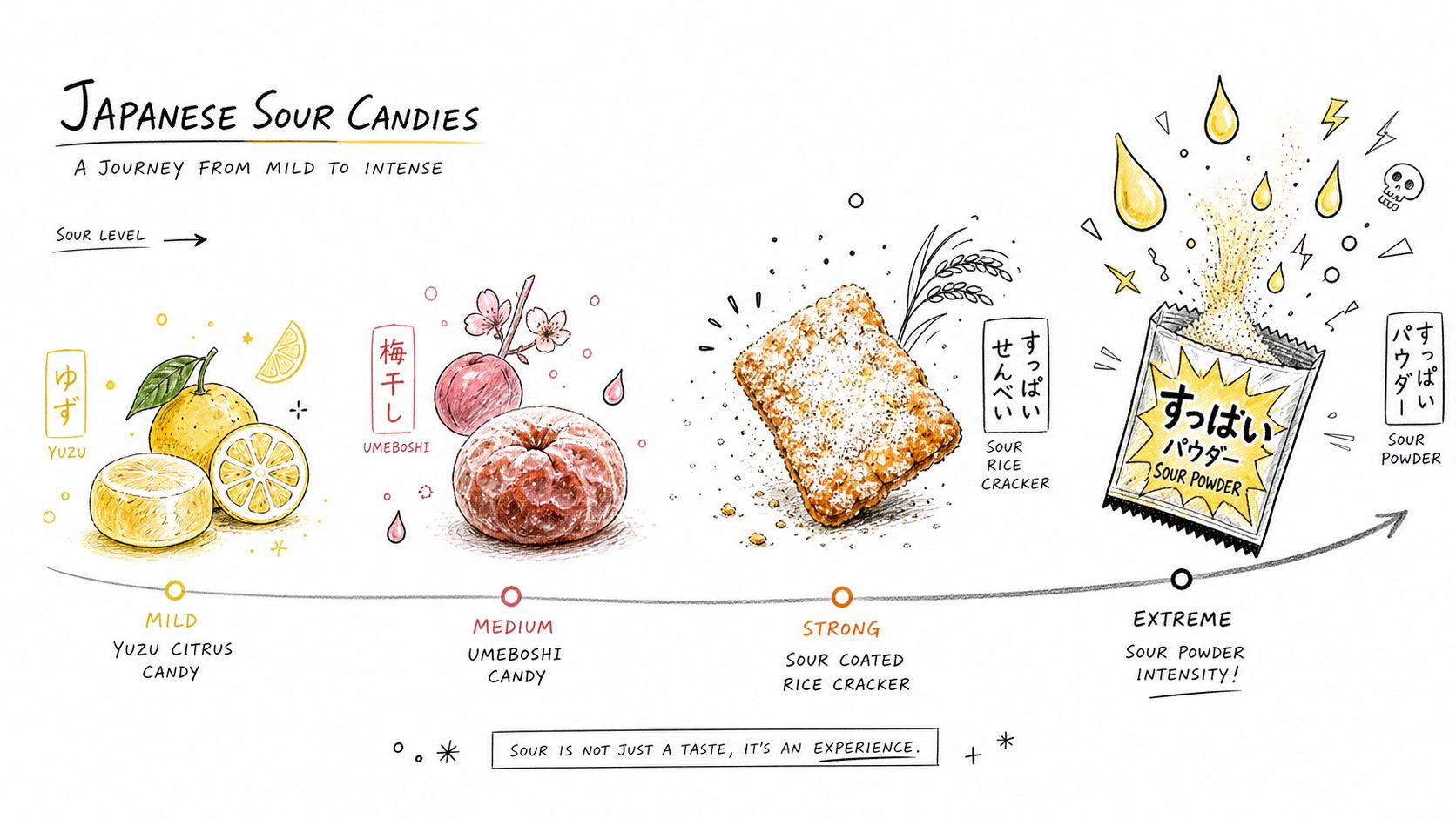
If your only frame for Japanese sour candy comes from someone wincing on a camera, you're looking at a tiny corner of a much larger candy culture. The viral challenge version is real, but it doesn't explain why sour flavors sit comfortably beside plum, citrus, vinegar, and salty-sour snacks in Japan, or why candy makers there have spent generations refining texture as carefully as taste.
That matters because Japanese sour candy is not just about punishment. It's part of a confectionery tradition shaped by history, seasonal novelty, and a taste for balance, which is a very different starting point from Western extreme-sour contests.
Why Japanese Sour Candy Is Not What You Think
Many first encounter Japanese sour candy through a reaction video. Someone pops a piece into their mouth, their face tightens, and the whole experience is framed as a test of endurance. That's entertaining, but it leaves out the everyday candies that Japanese shoppers buy for flavor, texture, and sharing.

Sour as part of a wider flavor language
In Japan, sourness often sits inside a broader flavor family instead of standing alone as a dare. Plum, citrus, vinegar, and salty-sour notes show up in snacks that people eat casually, not just as a stunt. That's why many products that English speakers would group together as “sour candy” feel more layered and less aggressive once you taste them.
Practical rule: if a candy looks famous for being “extreme,” don't assume that's the whole category. Some of the most interesting Japanese sour candy is the kind that builds slowly, balances sweetness, and still feels approachable.
The difference shows up in how people talk about flavor. Western novelty culture often rewards the biggest grimace, while Japanese snack culture gives room to tartness, subtle fruit notes, and a cleaner finish. That's one reason the same candy can read as “shock value” to one buyer and “pleasantly tangy” to another.
The easiest way to reframe the category is to stop asking whether a candy is “hardcore enough.” Ask what flavor family it belongs to, what else is happening on the palate, and whether it would work as a gift or a shared snack. That question leads to the story behind the sweets.
A cultural fit, not a gimmick
Japanese candy makers have long treated sourness as one note in a bigger composition. It can brighten plum, sharpen citrus, or cut through sweetness without taking over the whole bite. That is why a bag of candy can feel playful without becoming a challenge.
The broader point is simple. If you come in expecting only face-puckering novelty, you'll miss the part that makes the category interesting in the first place. Japanese sour candy makes more sense when you treat it as a flavored snack tradition, not a dare.
The Historical Roots of Japanese Candy Culture
Japanese candy culture grew over a long stretch of history, and that background helps explain why sour flavors fit so comfortably into modern snacks. Historical records describe hard candy in Japan during the Nara period in the 8th century, so sweets have been part of the story for a very long time. By the Edo period, from 1603 to 1868, candy had entered everyday life, with street sellers appearing publicly and black sugar circulating more widely. That made sweets less rare and more familiar. A useful overview of that long history appears in Sakura Co.
From scarcity to variety
A major shift came in the first half of the 18th century, when Tokugawa Yoshimune encouraged domestic sugar production by ordering sugarcane planted across Japan to reduce the country's trade deficit. Sugar availability shapes what a candy culture can become. Once sugar was less scarce, makers could experiment more freely with texture, regional styles, and flavor contrasts.
The growth of candy culture also sat alongside wider folk traditions. For readers who enjoy how Japanese sweets carry stories as well as flavor, the story behind Japan's moon bunny confectionery tradition offers a useful cultural parallel. It shows how dessert in Japan often connects to seasonal memory, local custom, and symbolic meaning, not only to taste.
The result was more than a larger supply of sweets. It was a confectionery tradition that came to value distinction, from hard candies to black sugar treats to regional specialties. Sourness fits into that lineage because it gives makers another way to shape contrast, especially when they want tartness to sharpen fruit or balance sweetness.
Why this history matters to modern sour candy
If sugar had remained scarce and mostly imported, candy culture would likely have developed in a narrower way. Instead, Japan built a sweets culture that rewards variety, and that included flavor profiles that feel tart, sharp, or lightly acidic. That is why today's Japanese sour candy does not feel like an imported novelty sitting awkwardly in a dessert aisle. It feels like a continuation of a long pattern of experimentation.
You can see that continuity in the scale of Japanese confectionery as a national market. One source notes that Japan is the largest confectionery market in the Asia-Pacific region and the largest consumer of chocolate, which helps explain why candy brands can become national phenomena so quickly. The path from scarce sugar to broad domestic availability set the stage for that scale.
For shoppers, the takeaway is practical. Sour candy in Japan is not an odd side branch of snack culture. It grows from a sweets tradition that has had centuries to learn how to balance novelty, texture, and flavor.
How Japanese Sour Candies Create Their Signature Taste
The sharp bite in many Japanese sour candies usually comes from a two-acid system, not from one blunt sour ingredient doing all the work. Malic acid gives a faster initial spike because it lands more front-loaded on the palate. Citric acid is more water-soluble, so it can keep the sour impression going after the first hit.
Why the sour hit feels layered
That difference matters because the experience unfolds in stages. The first second can feel bright and immediate, then the sourness stretches out a bit longer instead of disappearing at once. If you've ever tasted a candy that seems to “open up” as you chew it, that's the kind of release pattern people are responding to.
A technical detail helps here. One sourced analysis reports that the surface pH of top-tier sour products can fall to about 2.2, which is acidic enough to create a strong trigeminal sting effect in the mouth. In plain language, that means the candy can produce a physical sour sensation, not just a flavor impression. For a buyer, that's a reminder that “sour” is partly chemistry, partly coating design, and partly how fast the acids are released.
What to look for: crystal size, coating thickness, and how the acid blend is distributed on the candy surface. Two products can read the same on an ingredient list and still taste very different.
Reading labels with more confidence
Many shoppers find this confusing. A candy labeled “extreme sour” might be intense for a few seconds and then calm down, while another one feels gentler at first but keeps building. That difference usually comes from the ratio of acids and how the coating behaves in the mouth.
So the smartest way to judge Japanese sour candy is not by the label alone. Look for clues about fruit type, coating, and whether the candy seems designed for an instant burst or a longer sour arc. Once you notice those patterns, the category becomes easier to understand and a lot more fun to sample.
Western Sour Challenges Compared to Japanese Sour Traditions
Western sour candy culture often leans into competition. The goal is to see who can endure the most intense piece, keep a straight face, or generate the best reaction for social media. Japanese sour candy can certainly be intense, but the tradition around it usually points somewhere else, toward balance, variety, and a smoother relationship between sour and sweet.
Different goals, different results
That difference changes the tasting experience in a very practical way. A Western challenge candy may be built to hit hard and fast, then fade into a joke. A Japanese candy is more likely to use sourness as one part of a fuller flavor sequence, which makes it easier for first-time buyers to enjoy it as candy instead of treating it like a test.
This is also why sour Japanese snacks often feel more giftable. You can hand them to someone who likes citrus, plum, or tangy fruit without worrying that the only possible reaction is shock. They can be fun without being punishing, and that matters when you're choosing something for a mixed group.
A lot of the confusion comes from category labels. In Japan, many sour-profile products are grouped under broader dagashi or fruit-candy traditions rather than under one single “sour candy” bucket, so English-language coverage can flatten a diverse category into one viral stereotype. The result is that shoppers looking for flavor often end up finding only challenge content.
A more grounded comparison
The cultural split is easy to miss if you only compare reaction videos. Western challenge candies are designed to be watched, while Japanese sour candies are often designed to be eaten, shared, and paired with other snacks. That is why they can feel more approachable even when they still have a clear bite.
If you're browsing in Japan or through an importer, this distinction helps you choose better. You're not just asking, “How sour is it?” You're asking whether the candy is meant for novelty, everyday snacking, or a gift box where flavor variety matters. That question leads to much better purchases.
One useful example of how Japanese goods are often presented for practical use is Hada Labo Gokujyun Premium Lotion 170ml (Moist Type), which shows how Japanese products are often described with clear function and texture, not hype. The same kind of clarity helps when you compare sour candies, because the most useful details are about sensation, not just bravado.
Notable Brands and Regional Sour Candy Varieties
Japan's confectionery market is large enough that mainstream sweet brands can become national fixtures, and that scale gives sour candy room to develop in many directions. One source notes that Japanese consumers eat about 350,000 tons of confectionery annually, a figure often paired with the idea that this works out to only about 100 calories per person per day University of Kansas. Read that alongside the rest of Japan's candy culture, and the pattern becomes clearer. Candy is not treated only as an occasional treat, so brands can test flavors without keeping sour candy in a novelty corner.
Brands that show the market's reach
Kanro shows how large a candy brand can become in Japan. Its soy-sauce candy has reportedly sold 5 billion bags cumulatively since its 1955 launch, and the company's 2024 fiscal-year sales reached 31.778 billion yen, up 9.5% year over year, with the company ranking first in Japan's overall candy market, first in hard candy, and second in gummies. Those figures, cited by the same University of Kansas source, show that unusual flavor ideas can become part of everyday buying rather than staying as a sideshow.
Japan's taste for flavor experimentation also appears in limited editions. The University of Kansas source describes more than 400 limited-edition seasonal and regional Kit Kat flavors produced in Japan since 2000, and over 300 seasonal and regional flavors sold more broadly. That habit of frequent variation helps explain why sour candy fits comfortably beside regional fruit, plum, and vinegar sweets. A tart flavor does not have to be dramatic to feel distinctly Japanese. It can be one more way a familiar ingredient is expressed.
From big brands to gift-ready assortments
The practical result is a market where you can find everything from mass-market sour pieces to small-batch regional sweets. For gift buyers, that matters because variety is part of the appeal. A curated box such as the Essential Japanese Snacks assortment is one way to sample that range in a single package, while savory items like Akasaka Kakiyama Arakashigo rice crackers show how sour-adjacent flavor notes can sit inside the broader snack culture. Gift Me Japan's Japanese gift set guide is useful here because it helps people sort through options without assuming that stronger sourness automatically means better quality or more authenticity.
What stands out is not just the existence of sour candy, but where it sits inside a large confectionery system. Japan gives candy makers room to keep sour products accessible, seasonal, regional, and giftable at the same time. That is a different model from the shock-value approach many Western readers expect, and it explains why Japanese sour candy often feels closer to a thoughtful snack category than a dare.
How to Choose and Gift Japanese Sour Candy
Choosing Japanese sour candy for a gift works better when you think about the recipient's comfort level, not just how intense the candy is. A lot of English-language content pushes extreme sour products, but those are rarely the safest choice for a present. Many people do better with something that feels interesting, attractive, and easy to share.
Start with flavor recognition
Look for profiles people already understand, such as yuzu or umeboshi. Those flavors give the candy a clear identity, and they help recipients connect the taste to something familiar even if they've never had Japanese sweets before. If someone likes citrus, a tart fruit piece makes more sense than a mystery candy built only for shock.
Gift rule: choose a sour candy box the same way you'd choose a dinner party wine. You want something with personality, but not something that dominates every other flavor at the table.
Variety matters too. A mixed snack box gives people options, which is useful when not everyone in the group wants the sour piece first. It also helps if the set includes sweet and savory items, because then the sour candy becomes part of a full tasting experience instead of the only thing in the box.
Use curated sets when you want less guesswork
Curated assortments reduce the work of sourcing authentic snacks abroad. Gift Me Japan's Japanese gift set guide is a useful reference point if you're trying to understand how these bundles are organized for gifting. The store's catalog also centers ready-to-give assortments sourced directly from Japan, which is helpful when authenticity and presentation matter more than hunting individual items.
A snack box is especially practical when you're gifting to someone who likes surprises but not extremes. You get the novelty of Japanese packaging, the variety of a mixed selection, and a much lower chance of picking the wrong intensity. That's the sweet spot for Japanese sour candy as a gift, approachable enough to enjoy, distinctive enough to remember.
If you're buying for a group, choose the box that lets people pick their own level of daring. The best gift is the one that turns tasting into conversation, not into a single forced reaction.
Practical Tips for Sampling and Enjoying Japanese Sour Candy
The easiest way to enjoy Japanese sour candy at home is to treat it like a tasting, not a stunt. Start with milder citrus or plum profiles, then move toward products with stronger acid coatings once you know what you like. Because the sourness often comes from a layered release, the first bite may not tell you everything.
A simple tasting order
If you're opening a mixed box, begin with the savory items, then move into fruit-forward sweets, and finish with the sharper sour pieces. That order keeps your palate from getting overwhelmed too early. It also makes the differences between candies easier to notice.
- Begin with milder profiles: citrus and plum usually give you a clearer sense of the candy's balance before the stronger sour products arrive.
- Watch the coating: thicker or more textured surfaces often release sourness differently from smooth pieces.
- Take a quick note: write down whether you prefer a fast hit, a lingering sour finish, or a softer tart edge.
Storage and shipping matter
Japanese sour candies can vary in heat sensitivity and shelf life, so store them in cool, dry conditions and check expiration dates before gifting, especially in summer. That matters more than people expect, because heat can change texture and weaken the experience. If a box is meant for travel, give yourself enough time for shipping and storage planning.
Keep the bag sealed until you're ready to serve it. Once air and heat start working on the candy, the texture can shift faster than you'd think.
For buyers who prefer a box format, the Japanese snack box with no subscription is a practical way to sample without committing to a recurring order. It fits the same basic idea as the tasting method above, variety first, intensity second. That makes it easier to learn what kind of sour candy you enjoy.
The biggest shift comes when you stop treating sourness as a dare and start treating it as preference. Once you know whether you like brisk citrus, softer plum, or a longer acidic finish, buying becomes much simpler.
If you want to explore Japanese sour candy as a giftable snack category instead of a viral challenge, Gift Me Japan curates ready-to-give Japanese snack sets and other imported goods in one place. Visit Gift Me Japan to browse assortments that make it easier to choose authentic Japanese treats for sharing, sampling, and thoughtful gifting.
Share:
Japanese Gift Set Guide: Curated Ideas for Every Occasion
Japanese Candy Chocolate: Flavors & Gift Guide 2026