

A small sachet of green and gold flakes appears beside the rice bowl, or tumbles out of a Japanese snack box, and the label reads nori tama furikake. It looks a little like confetti and smells of seaweed and toast. The usual questions follow. What is it, how much do you use, and can you hand it to someone as a gift without checking anything first?
The short answer is that it's a dry seasoning for rice, built on egg and seaweed, and it's about as ordinary in a Japanese kitchen as a salt shaker is elsewhere. What makes it worth a closer look is how much one small packet carries: a century of food history, a set of ingredients each doing a separate job, and a label that deserves reading before the parcel is sealed.
What Nori Tama Furikake Is and Where It Came From
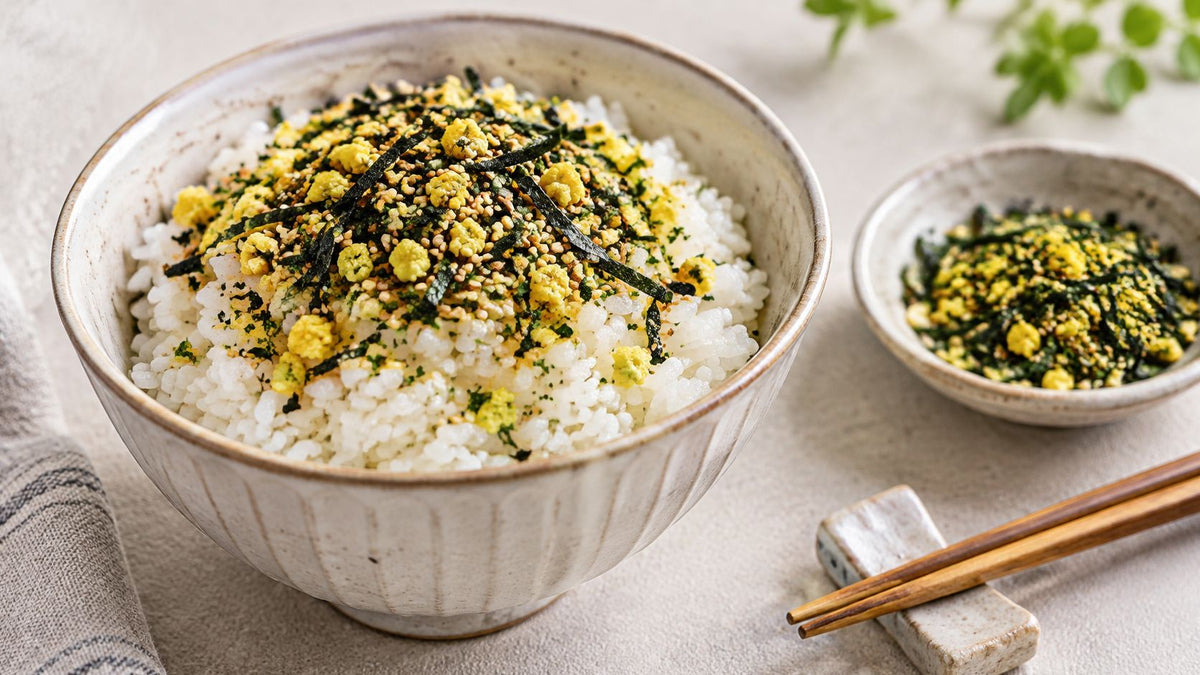
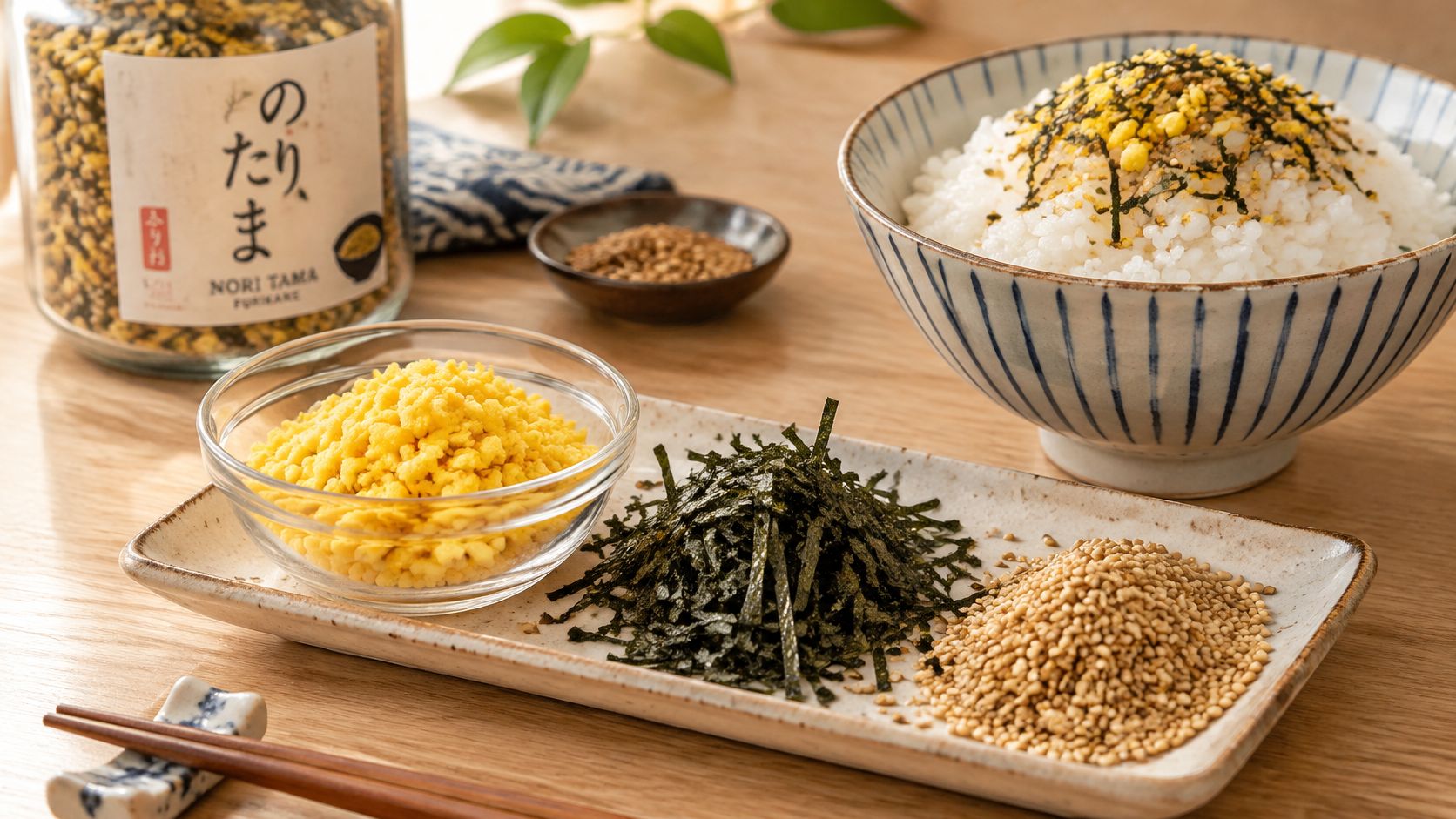
Nori tama furikake is a dry rice seasoning made from egg granules, shredded nori (dried laver seaweed), roasted sesame and savory seasonings. The name compresses two words, nori for the seaweed and tama as a short form of tamago, egg. You sprinkle it over hot rice and that is the entire technique, no cooking and no measuring beyond a pinch.
The format goes back further than most shoppers expect. Around 1913, a Kumamoto pharmacist named Suekichi Yoshimaru created Gohan no Tomo, "Friend of Rice," a powdered mix based on ground fish bones, seaweed and seeds, as the recorded history of the seasoning describes. He designed it partly so that a diet centered heavily on white rice would supply more calcium and other nutrients. Furikake began as a food supplement, which is why Japan treats the category as an everyday necessity rather than a novelty.
Marumiya's Noritama arrived decades later and changed the tone of the category entirely. A reference history of furikake dates its release to 1960 or 1961, with sources disagreeing by a single year, and records that it set off a boom in children's furikake. The same history notes the product has stayed in continuous production since launch and had been reformulated eight times by the 2010s, including reductions in salt and seasoning changes that followed shifting tastes.
Here's the seasoning in its everyday setting, sprinkled over a plain bowl of rice.
Shelves today hold fish, shiso, plum, bonito, wakame and adult-oriented blends, yet the basic Noritama formula of nori, dried egg, sesame and savory seasoning remains the benchmark. That matters when you're buying a gift. You aren't choosing a novelty, you're choosing an object with a documented place in Japanese home cooking, and recipients who care about food culture tend to notice the difference. The small, shelf-stable format also travels well beside Japanese rice crackers, which sit in the same pantry territory.
How Nori Tama Tastes, Ingredient by Ingredient
A spoonful of nori tama isn't one flavor. It's a small stack of jobs happening at once: something rich, something toasty, something from the sea, and something savory holding the whole thing together. Once you know which ingredient does which, the taste stops being a mystery and becomes predictable.
What each ingredient contributes
| Ingredient | Flavor role | What you taste |
|---|---|---|
| Egg granules and egg-yolk powder | Rich, mellow body | Soft, savory base |
| Roasted sesame | Toasty aroma | Nutty note on warm rice |
| Nori (laver) | Sea and marine notes | Clear seaweed aroma |
| Green-tea powder | Faint green edge | Light note in the background |
| Dried bonito and sardine extract | Deep umami | Savory backbone |
| Soy sauce and hydrolyzed protein | Umami and depth | Savory, salty finish |
| Sugar | Softens salt and bitterness | Rounded, less sharp taste |
| Salt | Seasoning baseline | Overall salty level |
The richness comes first from egg. Whole-egg and egg-yolk powders give the blend a soft, mellow body, the rounded quality you taste in a plain omelette, while roasted sesame adds the toasted note that lifts it. Nori supplies the marine side, clear and clean rather than fishy, and a little green-tea powder in some formulas adds a faint green edge in the background.
Then comes the savory layer, which is where the blend earns its depth. Dried bonito, dried sardine extract, soy sauce and hydrolyzed protein build umami through nucleotides and free amino acids, so a small amount reads as deeper than its volume suggests. Sugar does quiet work here, softening salt and bitterness so the seaweed never turns sharp.
Where similar names hide different formulas
Marumiya's Noritama is described as egg granules, shredded nori, roasted sesame, dried fish flakes and a matcha-seasoned salt. Tanaka's blend adds wheat protein, soy protein and hydrolyzed protein to its own version of the same idea. Neither is more authentic; they're different builds, which is why a generic description of "nori tama" will never tell you exactly what's in the packet in front of you.
Read the brand, not the category. Nutrition figures belong to one manufacturer's product, so never carry them across to a different packet with a similar name.
That caution applies directly to the numbers. For Tanaka's Nori Tamago, a standard 2.5 g serving supplies approximately 10.9 kcal, 0.5 g protein, 0.5 g fat, 1.1 g carbohydrate, 0.36 g salt equivalent and 8 mg calcium, according to the manufacturer's product specification. Those figures describe a garnish, not a meal. The seasoning is there to make a bowl of rice more interesting, not to add bulk.
Dry granules release their aroma on contact with warmth, which is why the smell arrives before the taste. Sprinkle onto rice that's still steaming and the egg and sesame open up. Sprinkle onto cold rice and you mostly get salt. If you enjoy that salty-savory snap at the edge of a snack, salty rice crackers work on the same principle.
Before you decide how you feel about nori tama, taste it plain. A small pinch on unsalted hot rice tells you what the blend is doing without interference from soy sauce, pickles or a heavy main dish. From there you can judge whether it needs more, and you'll know what it's contributing when you cook with it later.
Ways to Serve Nori Tama Furikake
Start with the plainest possible bowl. Hot steamed rice, a light sprinkle, nothing else. That's the reference point every other use builds on, and it's how the seasoning is eaten most often in Japan, where it belongs to a long-established packaged-food format tied to everyday meals, bento and onigiri, as a product description of Marumiya Noritama sets out.
| Serving style | How to use it | Why it works |
|---|---|---|
| Plain hot rice | Sprinkle a light layer over a warm bowl | Shows the egg and nori aroma directly |
| Onigiri and rice balls | Mix into rice before shaping, or dust the outside | Seasons every bite evenly |
| Bento lunches | Stir into the rice in the box | Dry format packs neatly |
| Okayu (rice porridge) | Stir in just before serving | Adds savory depth to a soft dish |
| Cucumber or salad | Scatter over sliced vegetables | Adds salty, toasted contrast |
| Popcorn or rice crackers | Light dusting after popping or baking | Quick savory snack |
The rule that applies to every method
Add it at the end. Nori tama is a topping, not an ingredient you cook, and heat is what releases its aroma. Stir it into a simmering pot and you lose the volatile notes that make it smell like toasted sesame and seaweed. Add it to the bowl and the same warmth does the work in front of you.
For onigiri, the choice is texture. Mixed through the rice before shaping, it seasons every grain and gives the rice ball an even speckled look. Dusted on the outside, it stays crisp against the sticky surface, which is better if you're eating within the hour. In a bento, stir it through the rice once it has cooled enough to handle, so the moisture doesn't turn the granules pasty.
Away from rice, the seasoning behaves like a savory finishing salt. Scatter it over sliced cucumber with a drop of sesame oil for a five-minute side dish. Stir a spoonful into warm okayu just before it comes off the heat, so the porridge stays loose and the topping keeps its texture. Dusted over popcorn or plain rice crackers, it turns a neutral snack savory in one step.
Portion control is worth a moment. Start with a small pinch per serving and taste before adding more, because the blend is already salted and a heavy hand flattens the rice instead of lifting it. If you want a broader sense of where this fits among Japanese foods, popular Japanese dishes shows how often a simple rice bowl anchors the meal.
Storing Nori Tama So the Flavor Lasts
One rule governs everything else. This is a dry product, and moisture and heat are what shorten its life. A sealed, dry packet keeps for a long time; an open one left beside the stove does not.
- Keep the original pouch. It's built for this format, with a barrier that a decorative jar won't match.
- Reseal immediately after each use, pressing the air out as you close it.
- Store away from heat, light and humidity. That means not above the stove, not beside the sink, and not on a sunny windowsill.
- Use a dry spoon or dry fingers. Steam from a hot bowl and damp hands are the usual cause of clumping.
- Don't return leftovers to the pack once they've touched a steaming bowl. Moisture travels back with them.
- Use it promptly after opening rather than letting it sit at the back of the cupboard for a season.
What a tired packet looks like
Clumping is the first sign, and it usually means humidity has got in. A dulled smell is the second. If the aroma has faded from toasty and marine to flat, or if there's any off or musty note, throw it out rather than trying to salvage the bowl. Repacking into an untested container weakens the moisture protection the original pouch provides, which is why it's better to leave the seasoning where it was sealed.
For a gift, hand over the pouch intact and mention resealing in your note. Check the date printed on the package before wrapping, especially if the packet has been in a drawer for a while.
Allergens and Labels to Check Before You Gift
The word seaweed does a lot of misleading work. A packet described as a seaweed-and-egg topping can also contain milk, wheat, soy, fish and chicken, and "seaweed-based" says nothing about whether it suits a vegetarian, someone avoiding gluten, or a child with a milk allergy.
Ingredient listings for nori tama commonly include sesame, processed egg, lactose and other dairy ingredients, wheat, soy, mackerel, chicken, bonito or seafood extracts and mirin, as an ingredient review of the seasoning sets out. That list explains why two questions come up so often: "is nori tama vegetarian?" and "is it safe for someone with an egg, milk, fish, sesame, soy or gluten allergy?" Neither has a generic answer, because formulas vary by manufacturer and by market.
Japanese labels and the limits of translation
Japan requires some allergens to be declared on packaging and leaves others to voluntary declaration, and the rules in the recipient's country may differ from Japan's. Our products are manufactured for the Japanese market and sold in accordance with applicable Japanese standards, and formulations, permitted ingredients, usage instructions and labelling requirements may differ between Japan and your country. Check official Japanese food labelling guidance alongside the package itself, and read the label for the market the gift is going to, not the one you bought it in.
| Ingredient | Allergen or diet concern | Where to check |
|---|---|---|
| Whole egg and egg-yolk powder | Egg | Ingredient list on the package |
| Lactose and other dairy ingredients | Milk | Ingredient list on the package |
| Dried bonito, sardine extract or mackerel | Fish | Ingredient list on the package |
| Chicken extract | Poultry; dietary status varies | Ingredient list on the package |
| Roasted sesame | Sesame | Ingredient list on the package |
| Soy sauce and soy protein | Soy | Ingredient list on the package |
| Wheat protein | Wheat and gluten | Ingredient list on the package |
| Mirin | Alcohol; vegetarian and halal status varies | Ingredient list on the package |
A short checklist before the box is sealed
- Check the destination market. A formula sold in one country can differ from the same brand name sold in another.
- Treat the ingredient list as the first check, not the product name or the picture on the front.
- Don't assume cross-contact is ruled out. A label describes ingredients, not shared production lines.
- Keep the original package. A translated list you typed yourself doesn't replace the printed one.
If the recipient has a serious allergy, contact Gift Me Japan before ordering and we'll help you check what's suitable. For broader snack pairing ideas that make the label check easier to plan around, Japanese snacks to give as gifts covers the practical side of building a mixed selection.
Choose Nori Tama for Your Next Japanese Snack Gift
Japanese gift calendars offer two natural anchors. Ochugen is exchanged in summer and oseibo in December, and Japan Guide's overview of seasonal gift giving notes both have commonly been shared among co-workers, friends and relatives, although the practice is gradually declining. Treat them as context rather than obligation. A packet of nori tama works just as well as a thank-you in July, a December appreciation present, or a small parcel for someone who collects Japanese pantry staples.
Who tends to appreciate it? Someone who already cooks short-grain rice and enjoys small upgrades to an ordinary meal. A recipient who ate this on a trip and would recognize the packet instantly. Anyone building an interest in Japanese home cooking rather than restaurant food. It's a modest item, which is exactly why it reads as thoughtful rather than expensive.
A few presentation habits make the difference. Pair it with other Japanese snacks in a selection, the same way a snacks care package builds a theme around a few well-chosen items, so the packet arrives as part of a theme rather than on its own. Slip in a note with one serving suggestion, such as a pinch over hot rice or mixed through rice before shaping onigiri. Don't assume wrapping, a gift box or a message card is included unless the listing you're buying from shows it.
Sizes and contents change, so verify rather than assume. One widely listed Marumiya Noritama pack is 25 g, as a current product listing for the seasoning shows, but the size and contents on the page you order from are the ones that count. If you're unsure how a particular set will read to a recipient, our team supports customers from product selection through delivery and beyond.
Three things are worth carrying away. Nori tama is a rice seasoning with a real origin story, not a novelty invented for export. Each ingredient does a separate job, which is why the blend tastes rounded rather than fishy. The label matters more than the category name, especially when the person receiving it has a dietary rule. Start there, and the choice becomes straightforward.
Gift Me Japan curates Japanese gift sets that bring snacks together with skincare, beauty and lifestyle pieces, all sourced directly from Japan, and a rice seasoning like nori tama slots naturally into a snack-led assortment for someone curious about Japanese food. Every set is put together with an occasion and a recipient in mind, so you can choose with confidence rather than guesswork. Explore the collections at Gift Me Japan and start with the ingredient list, then the occasion.


Share:
Collagen from Japan: Formats, Evidence and How to Choose