

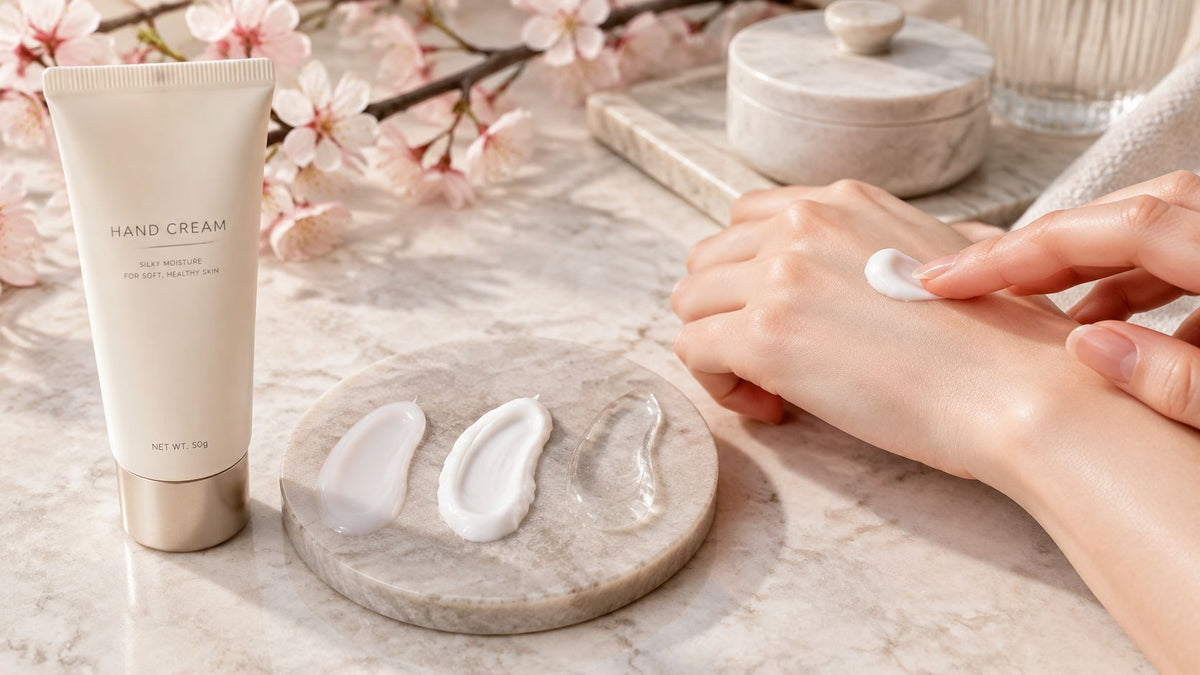
Japan's hand-care market recorded JPY 20,109.56 million in sales value in 2020, according to GlobalData's Japan hand-care analysis. Japanese hand cream belongs to an established everyday-care category, not just a niche for attractive beauty gifts. But a familiar category still contains very different products.
For a thoughtful gift, start with how the recipient uses their hands, then check the ingredients, fragrance and label. A cream for someone typing between meetings may need a different texture from one intended for bedtime. Attractive packaging can finish the present, but it shouldn't make the decision.
Japanese Hand Cream Textures and Formats Compared
| Format | Typical texture | Absorption | Best use |
|---|---|---|---|
| Lotion-style hand cream | Light, fluid | Fast | Daytime, frequent reapplication at a desk |
| Standard hand cream | Creamy, medium richness | Moderate | Everyday dryness, after handwashing |
| Rich emollient cream | Thick, cushioned | Slower | Rough or cracked hands, evening use |
| Ointment or balm | Dense, greasy | Slow, leaves a film | Very dry hands overnight |
| Gel-type hand cream | Cool, light | Very fast | Quick top-up, less film for very dry hands |
Emollient means an ingredient or formula that softens and smooths skin. An ointment usually prioritizes a protective, oily film over a dry finish. A gel-type hand cream describes its light texture, not a guaranteed level of moisturizing performance.
In a 2023 online survey of 4,000 adults aged 20 and older in Japan, hand cream was the most-used countermeasure for skin dryness, selected by 45%, with multiple answers allowed, according to Statista's survey summary. That makes it a recognizable daily-use gift, though the online sample shouldn't be treated as a census of every demographic.
Match the finish to the routine
Texture descriptions are useful starting points, not standardized performance grades. A product called a cream can feel surprisingly light, while a balm may leave a noticeable coating. Read the product's own description rather than relying on the format name alone.
For someone who handles papers, uses a phone or works at a keyboard, a quick-settling formula is easier to fit between tasks. For someone who enjoys an evening self-care routine, a richer finish may be welcome rather than inconvenient.
Containers matter, too. A tube can be convenient to carry and dispense, while a jar may suit a product that stays beside the bed. Don't assume either format includes a spatula, pouch or other accessory unless the listing shows it.
Richer isn't automatically more suitable
A heavy formula can be a poor gift if the recipient dislikes residue and rarely uses it. Conversely, a light gel may feel pleasant without providing the lasting film someone with very dry hands wants.
If the recipient is new to Japanese beauty, a beginner-friendly Japanese skincare routine can help place hand care within a manageable daily habit.
Practical rule: Choose the format the recipient will willingly reapply throughout the day. A cream that gets used is a more useful gift than a richer one left in a drawer.
What Ingredients Decide How a Hand Cream Works
A useful hand cream combines ingredients that do different jobs. Humectants, including glycerin and urea, help attract and retain water in the outer skin. Emollients, such as esters and plant oils, smooth rough texture, while occlusives, including petrolatum and dimethicone, form a film that slows water loss.
These roles overlap, so an oil may contribute both softness and a protective film. The important question is whether the complete formula supports moisture retention, not whether its front label highlights an appealing botanical.
| Ingredient | Role | Suits | Watch for |
|---|---|---|---|
| Glycerin | Humectant, draws water into the skin | Everyday dryness | Generally well tolerated |
| Urea | Humectant and softener of thickened skin | Rough, hardened hands | Higher levels can sting cracked skin |
| Ceramides | Support the skin's lipid layer | Dry or barrier-damaged hands | Patch-test before full use |
| Colloidal oatmeal | Moisturizing and barrier support | Dry or sensitive-feeling hands | Patch-test before full use |
| Panthenol | Moisturizing support | General dryness | Patch-test before full use |
| Petrolatum or dimethicone | Occlusive film that slows water loss | Overnight use, very dry hands | May leave a noticeable film, especially in richer formulas |
| Plant oils or esters | Emollient that smooths rough texture | Everyday softness | Can feel heavy on some hands |
| Fragrance | Scent, not a barrier-supporting ingredient | Personal preference | Can irritate sensitive skin |
Why combinations matter for hands
Repeated washing and sanitizer exposure can remove surface lipids, leaving hands less able to retain moisture. A clinical study published in Scientific Reports supports evaluating a combined humectant and lipid-rich formula rather than selecting a cream by a single featured ingredient.
Think of a hand cream as a coordinated formula. Glycerin helps with water retention, while accompanying emollients and occlusives help soften the surface and limit moisture loss. A floral extract doesn't replace those functions merely because it receives more space on the packaging.
A long ingredient list isn't proof of a better cream, either. Additional ingredients may contribute scent, texture, preservation or appearance without making the product more suitable for the recipient.
Make the ingredient list actionable
- Choose a complementary formula. Look for a humectant paired with an emollient or occlusive, rather than judging only by the ingredient advertised on the front.
- Apply after washing. Pat hands gently, then apply while the skin is still slightly damp.
When comparing Japanese skincare products by their purpose, use the same approach: identify the job the product needs to do, then check whether its formulation fits.
What Sets Japanese Hand Creams Apart and How to Read the Label
Japanese hand cream is made within a defined formulation and labeling framework. The Ministry of Health, Labour and Welfare's Standards for Cosmetic Products restrict certain ingredients and require that ingredients and impurities not make cosmetic use hazardous; for example, diethylene glycol must remain below 0.1 g per 100 g of glycerin.
That framework sets a safety baseline for every product sold under it. What remains for you to check is the fit between one specific formula and one specific recipient: their fragrance preferences, skin condition and intended use all sit on the label itself.
Read for identity, contents and traceability
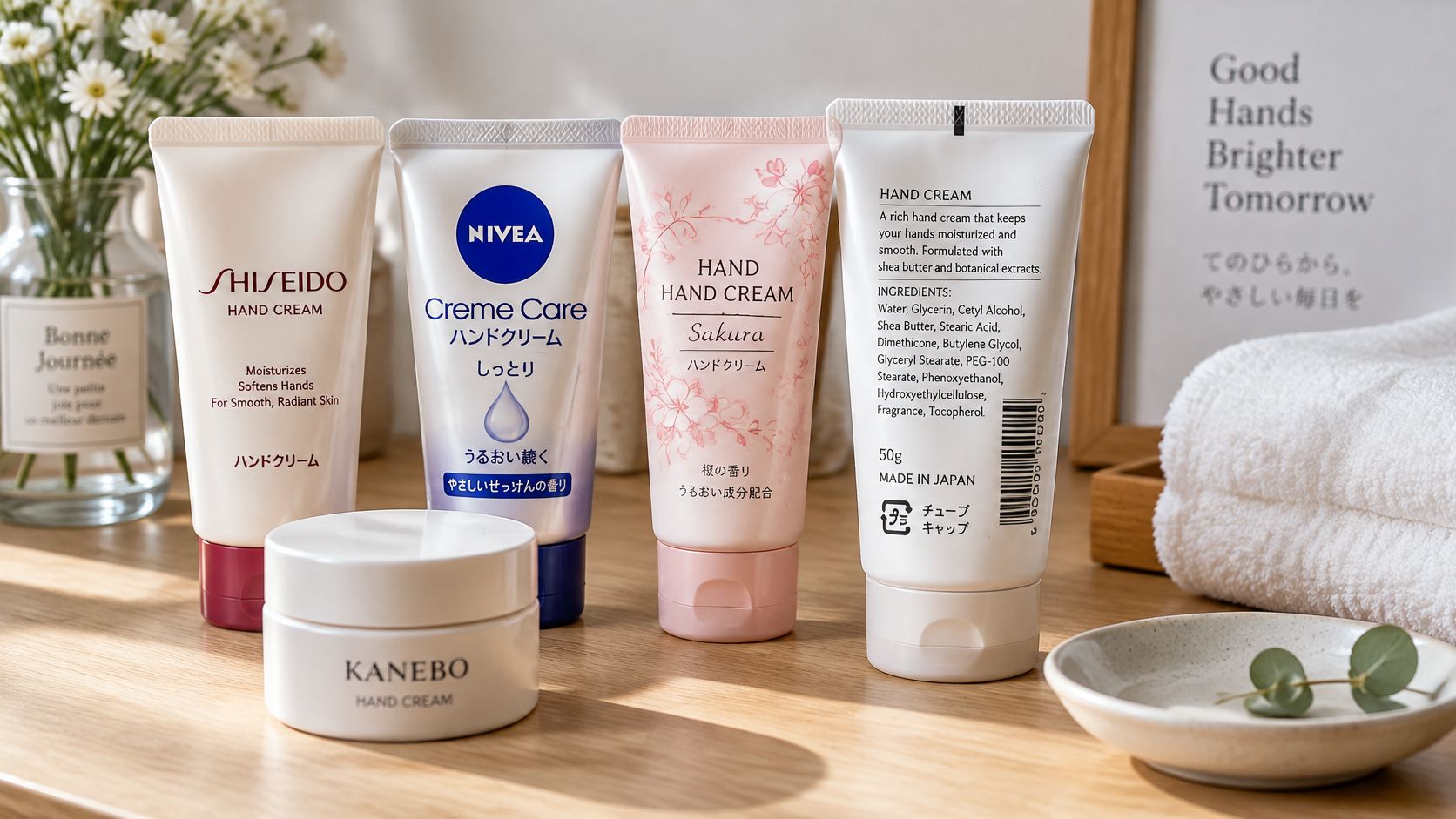
Japan cosmetics regulatory guidance identifies label details including the marketing license holder's name and address, product name, batch number, net weight and complete ingredient list using Japanese INCI conventions. These details let you compare contents accurately and identify the exact product if a question comes up later.
Use this checklist before committing to a gift:
- Find the product name and net weight. Confirm the exact item and amount printed on the label, since similar-looking tubes can hold different formulas or sizes.
- Locate the full ingredient list. Check for fragrance and any stated urea concentration; the front of the tube highlights marketing claims, while the back lists what is inside.
- Record the batch information. Japanese cosmetics often use a production or batch code in place of a printed expiry date.
- Keep the original packaging. The recipient then retains the instructions, ingredients and traceability information.
Account for domestic-market packaging
Gift Me Japan's products are manufactured for the Japanese market and sold in accordance with applicable Japanese standards. Formulations, permitted ingredients, usage instructions and labeling requirements may differ between Japan and your country.
A hand cream tube produced for the Japanese domestic market, for instance, typically prints its directions, warnings and ingredient list in Japanese. English product information is provided where available, so check the English details on the product page before buying, especially if the recipient needs to verify a particular ingredient.
For shoppers seeking authentic Japanese gifts online, provenance matters, and so does the recipient's ability to read and use what they have been given.
Reading Strength in Medicated and Everyday Creams
As a label-reading example rather than a shopping recommendation, Menturm U20 Cream illustrates why concentration matters. Its manufacturer's medicated cream information lists urea at 20.0 g per 100 g, equivalent to 20%, together with dipotassium glycyrrhizinate and tocopherol acetate at 0.5 g per 100 g each, and describes keratin-softening action for hardened skin alongside moisturizing action that helps preserve suppleness.
The same formula surrounds that active with white petrolatum, squalane, liquid paraffin, glycerin and dimethicone. Even a prominently stated percentage sits inside a broader moisturizing base, so read it as describing one component within the whole product.
Read a percentage as a clue to purpose
A concentration tells you more than a general claim such as intensive care, but it still needs context. Ask what that ingredient does at the stated strength, then ask whether that purpose matches the recipient's concern.
For urea, the distinction is especially useful. A formula intended to soften hardened skin serves a different purpose from a light cream chosen for comfortable desk-side use.
Match the strength to the stated purpose.
Consider these contrasting situations:
- Rough, thickened skin: A clearly labeled higher-urea product may fit the intended purpose, provided the recipient can use it comfortably and follows its instructions.
- Everyday maintenance: A lighter cream may be a better choice when the aim is regular application without a heavy finish.
- Unknown skin needs: Reserve the stronger option for a recipient who has described a matching concern; packaging that suggests intensive performance is a marketing cue, not evidence of need.
Don't compare unlike formulas by a single number
A percentage tells you how much of one ingredient the formula contains. Quality, richness and effectiveness still depend on the full composition, and two formulas with similar headline ingredients can feel different because of their supporting components.
A stated concentration helps you match a product to a need; the right choice is the one whose stated purpose fits the recipient.
For gift shopping, this favors a simple question: does the recipient want everyday comfort, or have they specifically asked for something for hardened skin? The recipient's own words answer that question far better than their occupation or appearance.
Applied to the U20 example, the 20% figure signals a specific job, softening hardened skin. A labeled cosmetic or medicated function describes what a product is designed to do within a stated scope, so check that scope against what the recipient wants before treating a higher number as a reason to buy.
Choosing a Cream for Sensitive or Cracked Hands
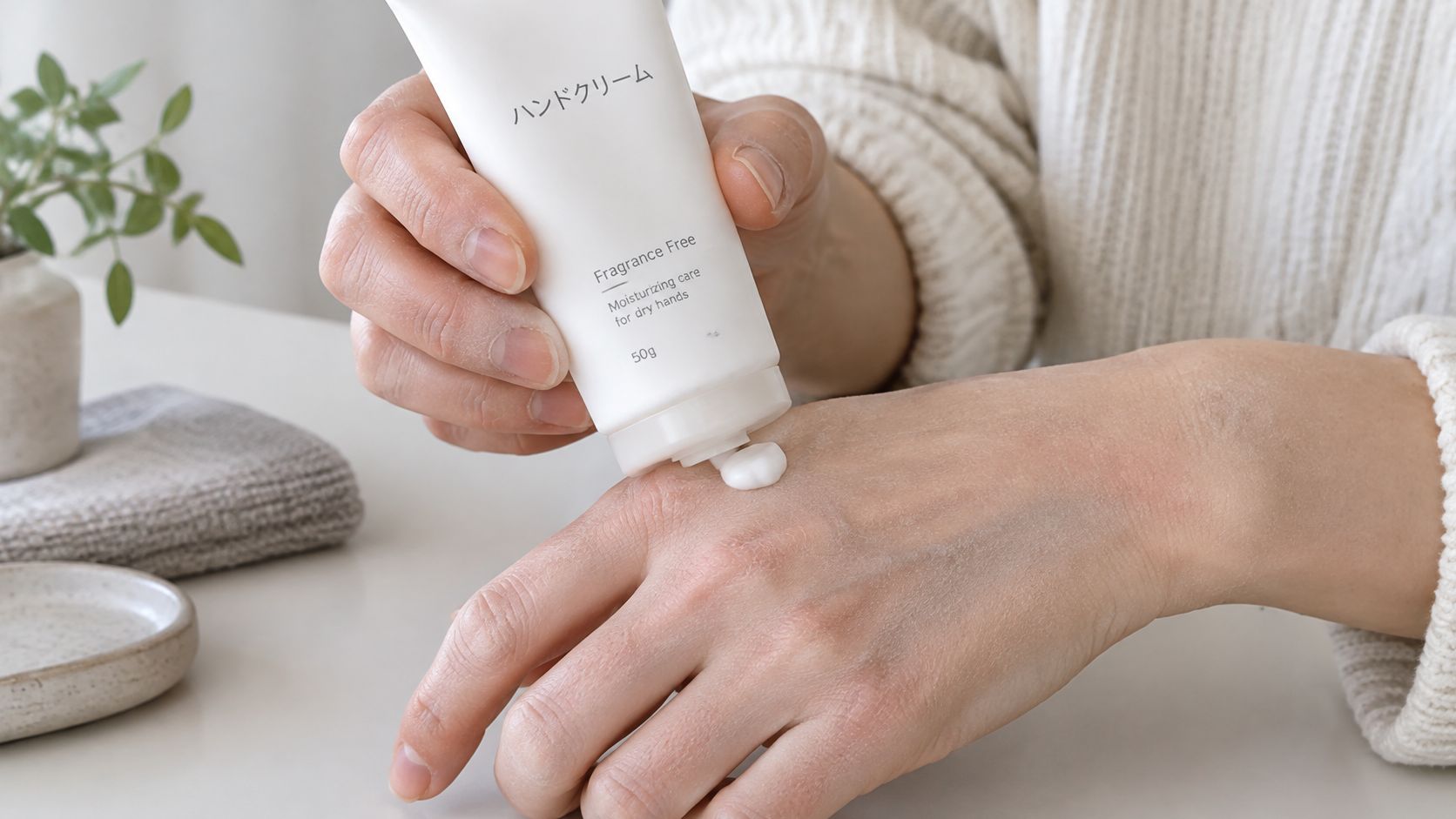
Unscented and Japanese-made don't automatically mean gentle. Fragrance-free is the more useful description when avoiding added fragrance ingredients, while unscented products can still contain fragrance used to mask raw-material odors.
Fragrance can aggravate irritation or allergic contact dermatitis. Preservatives, essential oils and some alcohols can also be problematic for particular users, so a natural claim doesn't establish suitability; clinical guidance on chronic hand eczema emphasizes careful product selection and regular moisturizing.
Choose support without promising treatment
Ceramides, colloidal oatmeal and panthenol are useful ingredients to consider for dry, sensitive-feeling hands. Urea also has a role, but lower concentrations primarily support hydration, while stronger formulas can sting fissured skin.
A double-blind randomized moisturizer study in the British Journal of Dermatology found that some moisturizers helped preserve barrier performance during repeated handwashing. That supports consistent moisturizing, not a guarantee that any cosmetic cream will resolve eczema or dermatitis.
Use a cautious introduction
- Choose fragrance-free. Check the complete formula against any ingredients the recipient already knows they must avoid.
- Try a small area first. Stop using the product if irritation develops; a home patch test can't rule out every allergy.
- Build it into washing habits. Apply after gently drying the hands, rather than waiting until they feel uncomfortable.
The same careful label reading is useful when choosing Japanese sunscreen for sensitive skin, although tolerance of one product doesn't guarantee tolerance of another.
Persistent cracks, bleeding, pain or continuing inflammation warrant medical assessment. Don't present a gift cream as a substitute for that care, and if the recipient has a serious allergy, contact Gift Me Japan before ordering so we can help clarify the available product information.
Matching a Hand Cream to the Recipient
| Recipient or need | Suggested format | Fragrance | Note |
|---|---|---|---|
| Colleague or host, sensitivities unknown | Standard cream | Fragrance-free | Check the clearly labeled ingredient list |
| Fan of Japanese beauty rituals | Standard or lotion-style cream | Lightly scented or scented, if welcomed | Check the label for fragrance |
| Very dry or cracked hands | Rich cream or ointment | Fragrance-free | Review sensitive-skin suitability before buying |
| Frequent handwashing at work | Quick-absorbing lotion | Fragrance-free | Reapplies easily between tasks |
| Traveller | Lotion-style or gel-type | Personal preference | Check the listed size before packing |
The most helpful distinction is between a practical gift with few assumptions and a more personal sensory gift. A colleague or host may appreciate straightforward, function-led care. Someone who already enjoys scented beauty products may welcome a fragrance chosen around their known preferences.
Japanese gift exchange extends beyond birthdays. Occasions include New Year, Valentine's Day, Christmas, a child's birth, school entrance and graduation, moving house and building a new home, within a wider culture of year-round giving described by the Japan National Tourism Organization's gift-giving overview.
Build a pairing around an interest
These are pairing ideas, not descriptions of currently available sets. Choose only combinations whose exact items and contents you can confirm on their product pages.
- For a beauty enthusiast's birthday: Hand cream with complementary skincare keeps the theme focused on a familiar interest. Choose compatible product purposes rather than adding unfamiliar strong formulas.
- For a host or housewarming: A function-led cream with a small lifestyle item creates a practical present. Keep scent restrained unless you know the recipient's taste.
- For a seasonal thank-you: Hand cream with Japanese snacks offers both a useful item and something to enjoy. Keep food labels intact and check current ingredients and dietary information.
These combinations don't require the recipient's clothing measurements, but they still benefit from personal knowledge. A traveller may care about packability; a frequent handwasher may value easy dispensing more than decorative presentation.
Keep the selection recipient-led
Budget can determine how many items you include, but it shouldn't change the basic suitability checks. A modest, well-matched cream can be more considerate than a larger assortment with unwanted fragrance.
Use Japanese skincare gift ideas organized around recipient preferences as inspiration without assuming interests from gender. Confirm every item, quantity, size and variant, and assume wrapping, cards or gift boxes are included only when the listing explicitly shows them.
Confirm These Points Before You Order
Run the last check like a label read, not a first impression: format first, then fragrance and formula, then the listing facts that prove the item is what you think it is. Packaging can signal care, but it cannot tell you whether the cream suits the recipient's hands.
Confirm only what the page can prove
- Product identity: Exact name, net weight, variant and any visible batch or production code. Japanese cosmetics often use a production or batch code instead of printing an expiry date, so if no code is shown, ask before ordering rather than guessing.
- Market and language: Many products are made for the Japanese domestic market, so packaging and printed instructions may be primarily in Japanese, with English product information provided where available. Formulations, permitted ingredients, usage instructions and labelling can also differ between Japan and the destination country.
- Contents and wrapping: Count only the items and packaging named in the listing, not accessories used for styling in photos.
- Allergy caution: If the recipient has a serious allergy, contact Gift Me Japan before ordering.
- Timing: Check current delivery information for the destination and occasion, not an older order or a general shipping description.
Gift Me Japan sells curated Japanese skincare selections and genuine products sourced in Japan through established suppliers and distribution channels, shipped directly from Japan.
Keep the original label with the gift so the recipient can read the ingredients and instructions that came with the product. Browse Gift Me Japan, then confirm contents, product details and availability before choosing.
Final check: Format tells you how the cream fits a routine, ingredients explain what it can support, and the label shows what you can verify.
Share:
Cherry Blossom Tea: Flavor, Brewing and Japanese Tradition
Japan Eyelash Serum: What It Is and What to Check