

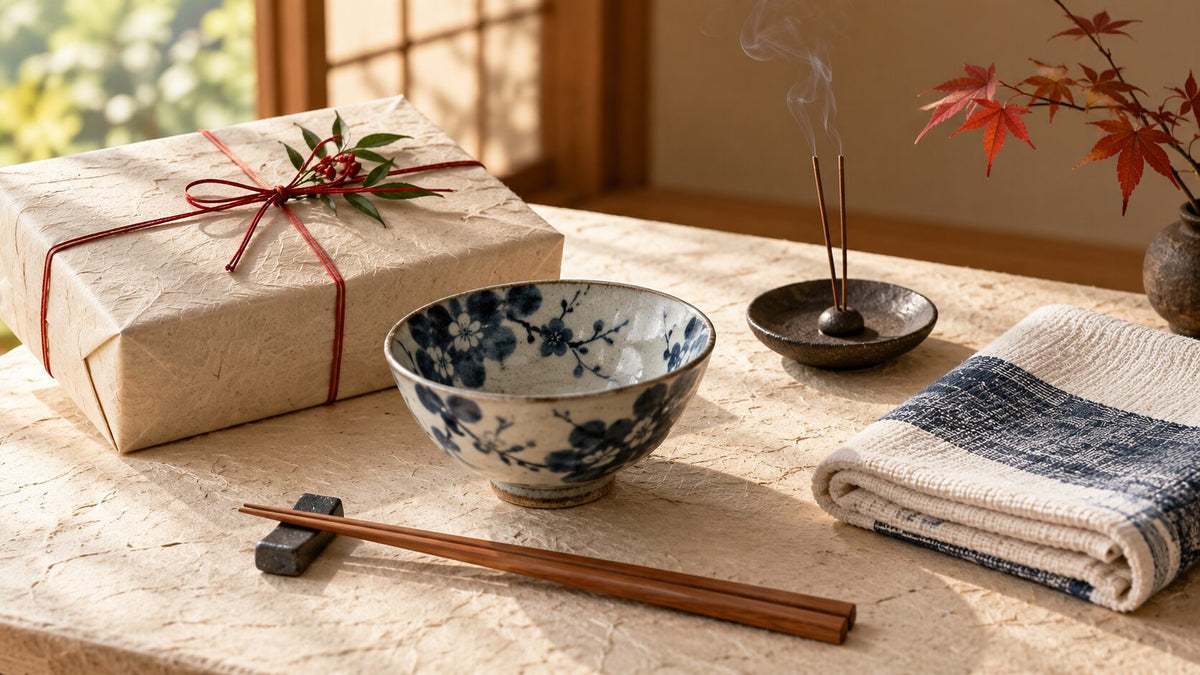
A gift made in Japan feels distinctive when its origin matters to the way it is made or used. That might mean Mino Ware for the table, Wakasa lacquerware for everyday dining, Imabari textiles for the home, or Japanese incense chosen for a quiet personal ritual.
The best choice is not necessarily the most ornate one. A useful object with clear materials, a named maker or production tradition, and a strong connection to the recipient will usually be remembered longer than a generic souvenir.
What makes a made-in-Japan gift worth choosing?
Start with information rather than appearance. Japanese motifs and attractive packaging do not prove where an item was made. A trustworthy listing should identify the manufacturer or vendor, the place of production where relevant, the materials, the dimensions, and exactly what is included.
Use three questions to narrow the search:
- Will the recipient use it? Think about their cooking, dining, home, travel, or personal rituals.
- Can you explain what makes it Japanese? Look for a specific craft, maker, region, material, or everyday custom.
- Can it reach them safely? Consider fragility, fragrance preferences, care instructions, and international shipping.
If you can explain in one honest sentence why the item suits the person, the gift already has a clearer story.
Four distinctive Japanese gifts from the current catalog
These active Gift Me Japan products were verified against the live catalog on September 24, 2026. Product details and availability can change, so check the current listing before ordering.
1. Mino Ware for someone who appreciates everyday ceramics
Japanese Mino Ware Porcelain Rice Bowl Blue Sendan Tokusa Pattern 13cm is made in Japan and combines a familiar blue-and-white palette with the linear Sendan Tokusa pattern. Its 13 cm size makes it a practical single-person gift rather than a large decorative piece.
This bowl suits someone who enjoys cooking, Japanese tableware, or carefully chosen household objects. Give it on its own for a modest birthday or thank-you, or pair it with a favorite rice or tea only when the recipient’s dietary needs are known.

2. Wakasa lacquered chopsticks for a keen home cook
ISSOU Wakasa Lacquered Chopsticks with Paulownia Wooden Gift Box 23cm offer a compact way to give a Japanese craft object that can become part of an everyday meal. The listing identifies natural wood, a lacquered finish, gold-leaf detail, and a paulownia presentation box.
They are a thoughtful choice for someone who already uses chopsticks or enjoys Japanese cooking. Because size and handling preferences are personal, confirm the 23 cm length before buying rather than assuming one style suits everyone.

3. Imabari towels for a useful housewarming gift
Imabari Towel Premium White & Navy Face Towels Wooden Gift Box (Set of 2) contains two Japanese-made cotton face towels in a restrained white-and-navy color scheme. The wooden box gives the set a finished presentation while the towels remain practical enough for daily use.
This is a strong option for a housewarming, wedding, host thank-you, or recipient who prefers useful home goods to decorative souvenirs. Towels also avoid the ingredient and fragrance questions that come with food, cosmetics, and incense.

4. Eirakuya incense for someone who already enjoys fragrance
Eirakuya Organic Japanese Incense With Paulownia Gift Box (Cherry Blossom & Bamboo) pairs two fragrances in a paulownia gift box. The compact format suits a birthday, thank-you, or quiet at-home occasion.
Incense is most appropriate when you know the recipient enjoys scented products and has a safe, ventilated place to burn it. Avoid presenting fragrance as a wellness treatment, and do not assume that every recipient will enjoy the same scent profile.

How to judge authenticity without relying on clichés
A product does not need to look traditional to be genuinely Japanese. Modern colors, simple shapes, and practical packaging can still reflect Japanese manufacturing and daily life. Focus on verifiable details:
- Origin: Look for a clear made-in-Japan statement or a named Japanese producer.
- Specificity: A named ware, maker, material, or technique is more useful than broad words such as “authentic” or “premium.”
- Accurate contents: Check the quantity, size, materials, included accessories, and packaging.
- Realistic use: Choose an object that fits the recipient’s home and habits.
- Care requirements: Review washing, storage, handling, and safety guidance on the current product page.
Natural variation can be part of a ceramic or handcrafted object, but damage is not a mark of authenticity. Inspect the seller’s images and description carefully, especially when buying fragile products online.
Match the gift to the recipient
For a home cook, tableware or chopsticks offers an obvious connection to a routine they already enjoy. For a new home, towels or coordinated ceramics are useful without demanding a highly personal taste. Incense can feel intimate and considered, but only when fragrance is already part of the recipient’s life.
Avoid choosing primarily by age or gender. Interests are a better guide. The same bowl could suit a student furnishing a first apartment, a collector of blue-and-white ceramics, or a friend who enjoys serving Japanese meals.
Presentation should clarify the gift, not compensate for a weak choice. A brief note such as “I chose this bowl because you always make dinner feel special” gives the recipient a reason to connect with the object. Confirm whether a box or wrapping is actually included before describing it as part of the product.
Plan for international shipping
Before ordering, confirm the destination, product availability, shipping charge, delivery estimate, and tracking terms. Ceramics require careful handling; fragrance products may need additional consideration; and duties or taxes depend on the destination. A gift label does not automatically remove local import requirements.
Allow extra time for holidays and customs processing, and treat delivery dates as estimates. The current Gift Me Japan shipping policy is the best place to check store-specific terms before checkout.
A simple final checklist
- Is the product’s Japanese origin clearly stated?
- Does the listing identify its materials, dimensions, and contents?
- Will the recipient realistically use or enjoy it?
- Have you checked fragrance, care, or dietary considerations where relevant?
- Can it be shipped safely to the destination?
- Can you explain why you chose it in one sincere sentence?
Unique gifts made in Japan stand out when the connection between origin and use is easy to understand. Choose a well-described product that fits the recipient, verify the live listing, and let the object’s materials and purpose carry the story.
Share:
Affordable Japanese Gifts Under $50 That Feel Thoughtful
Japanese Gifts for Someone Who Has Everything