


You've just stepped out of a humid summer shower, towel in hand, with a blow-dryer waiting on the counter. The hair at your ends feels rougher than it did a few months ago, yet the styling routine that gives you smoothness may also be adding stress. Choosing a Japanese heat-protection hair product can help, but only if you understand what it protects against, how its formula works, and when to apply it.
For an international gift shopper, that distinction matters. A mist, milk, oil, or serum can be a thoughtful self-care present, but the most suitable choice depends on the recipient's hair texture, porosity, styling habits, and comfort with fragrance or richer finishes. The best gift is one that fits naturally into an existing routine.
The Japanese Approach to Thermal and Environmental Hair Care
Japanese hair care often treats protection as part of daily maintenance rather than a single step reserved for special-occasion styling. A product used before a dryer or iron may also be expected to smooth, condition, reduce friction, and help hair cope with environmental exposure. That multifunctional approach makes Japanese heat-protection hair products especially relevant to thoughtful beauty gifting.
A July 2024 online survey of 100 people aged 20 and above found that 85% of respondents knew ultraviolet exposure could burn or damage hair, while 48% said they used a dedicated hair-sun-protection product. The figures suggest a meaningful awareness–usage gap, although the small, self-reported sample should be treated as an indicative consumer signal rather than a national estimate. The survey results and methodology are available from the Japanese consumer research announcement.
The same survey found that 42% of respondents identified the rainy season as the period when hair problems occurred most easily, while ultraviolet radiation in Japan is generally strongest during July and August. For shoppers outside Japan, the lesson isn't that every protective product serves the same purpose. It's that “heat protection” can reasonably include styling heat, sunlight, humidity, and the drying effects of seasonal conditions.
Why multifunctional formulas suit gifting
Japan's hair-care category is mature and substantial. One estimate values the market at approximately US$5.15 billion in 2025 and projects US$6.58 billion by 2031, with a forecast compound annual growth rate of 4.16% from 2026 to 2031. Another estimate places the market at US$4.8 billion in 2026 and forecasts US$6.66 billion by 2035, with a 3.70% compound annual growth rate. The different figures reflect different definitions and forecast periods, but both describe a multibillion-dollar category with steady expansion. The market estimates and methodology context are provided by Mordor Intelligence.
This context helps explain why a Japanese leave-in product may combine a thermal barrier with moisturizing, smoothing, or repair-oriented conditioning. It isn't necessarily designed only for someone who uses a flat iron every day. A lightweight spray can suit a frequent blow-dryer user, while a richer milk or serum may appeal to someone with dry, colored, or porous ends.
For a gift, that versatility is valuable. A product can become part of a morning styling ritual, a summer-care routine, or a small act of evening self-care. You can explore the distinction between smoothing and moisture-focused routines in this guide to Japanese hair oil for frizzy hair, while remembering that an oil's feel and application needs may differ from those of a dedicated heat-protection spray.
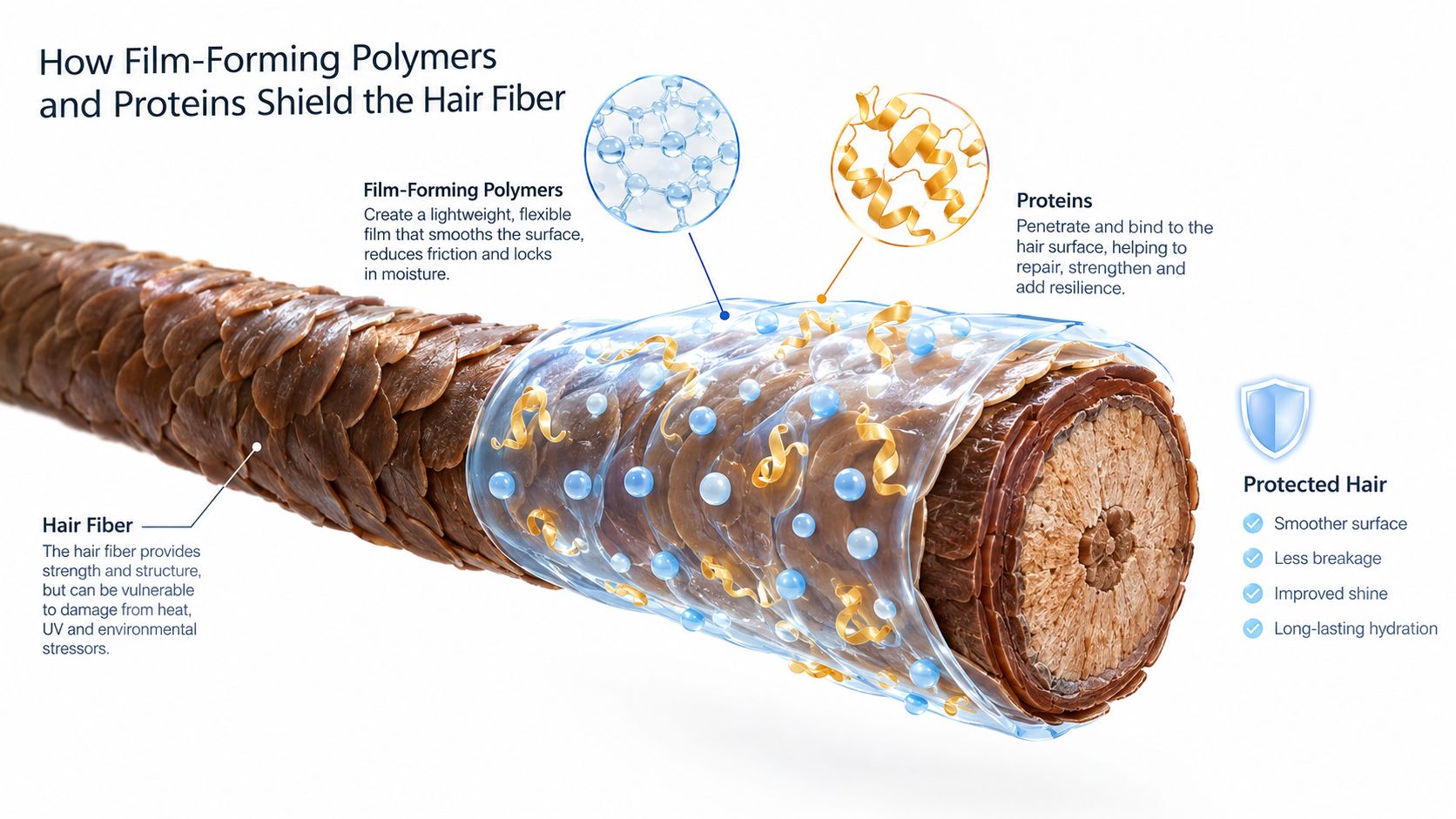
How Film-Forming Polymers and Proteins Shield the Hair Fiber
The phrase “thermal care” sounds broad, so ingredient literacy helps. Effective protection doesn't come from a product merely being labeled Japanese, botanical, nourishing, or repairing. It depends substantially on whether the formula deposits a continuous film across the hair surface and how that film behaves during heat exposure.
What the protective film does
Hair contains a protective outer cuticle and an inner cortex made largely of keratin. Heat, friction, repeated tool passes, and chemical processing can affect both the surface and the cortical structure. A film-forming polymer can help create a more even coating, reducing direct contact between the hot tool and the fiber and helping distribute stress across the treated area.
Controlled hair-switch experiments examined several polymer pretreatments, including VP/acrylates/lauryl methacrylate copolymer, polyquaternium-55, and a PVM/MA–polyquaternium-28 polyelectrolyte complex. The selected treatments reduced breakage and limited surface damage and thermal degradation of cortical keratin under the tested conditions. The PubMed record describes the experimental methods and polymer findings.
That doesn't mean a polymer makes hair immune to heat. Coverage must be reasonably uniform, especially from the mid-lengths to the ends, where older and more processed hair often needs the most support. A product can also make hair feel smoother without proving that it prevents every form of structural damage.
Ingredient-reading rule: Look for substantive film-forming or cationic polymers, not just the word “repair” on the front label.
Hydrolyzed proteins and polyamino acids fit a similar logic. A Japanese hair heat-protection patent describes a coating approach using hydrolyzed proteins, derivatives of hydrolyzed proteins, and polyamino acids. These materials are grouped for their film-forming role, not as a guarantee that every protein-containing formula performs identically. Read the Japanese patent's description of the proposed coating mechanism.
Read the label without overpromising
A thoughtful shopper should separate three different claims:
- Surface feel: The product may improve slip, shine, or smoothness.
- Cosmetic manageability: The hair may comb more easily or look less frizzy.
- Structural support: A controlled test may show reduced breakage or thermal degradation.
Those outcomes overlap, but they aren't interchangeable. A glossy finish can be useful and enjoyable, yet it doesn't by itself prove reduced internal damage. For more context on how conditioning fits into a broader routine, see this explanation of Japanese hair conditioner.
This is why a film-forming formula makes a particularly intelligent gift. It offers a tangible sensory benefit while also reflecting a more thoughtful approach to hair care. The recipient can enjoy softness immediately, but the product still deserves to be used alongside sensible temperature control and limited heat exposure.
Matching Formulations to Hair Porosity and Styling Habits
There isn't one universal heat protectant. Fine hair can become limp under a heavy oil, while porous or chemically treated hair may need more conditioning than a very light mist can provide. Curly hair also has different priorities from straight hair, especially when the recipient wants to preserve texture rather than create a sleek finish.
Use the recipient's routine as your starting point. Does the person mainly blow-dry, use a direct iron, refresh dry hair, or style only occasionally? Do the ends feel rough and absorb products quickly, or does the hair lose volume after a small amount of leave-in care?
Selecting Japanese Heat Protection by Hair Type
| Hair Profile | Ideal Formulation | Key Ingredients to Seek |
|---|---|---|
| Fine hair that loses volume easily | Lightweight mist, milk, or fluid leave-in | Volatile solvents, light film-formers, low-residue conditioning agents |
| Porous, bleached, or chemically treated hair | Conditioning milk, cream, or balanced serum | Film-forming polymers, hydrolyzed proteins, substantive conditioners |
| Thick or coarse hair | Richer cream, serum, or oil-supported formula | Smoothing polymers, conditioning agents, carefully chosen oils |
| Curly or textured hair | Evenly distributed cream or milk that supports slip | Film-formers, conditioning polymers, moisture-supporting ingredients |
| Hair styled mainly with a blow-dryer | Towel-dry-compatible spray, milk, or cream | Heat-activated or film-forming polymers, conditioning ingredients |
| Hair styled with a flat iron | Product that can be applied and dried according to its label | Film-formers, smoothing agents, clear dry-hair application guidance |
The table is a selection framework, not a promise of identical results. Research on cosmetic pretreatments found that selected polymers can reduce breakage and protect the hair surface and cortical keratin during flat-ironing, while newer work on thermoresponsive silicon-modified keratin reported a 30.26% gloss improvement and 39.33% frizz reduction after treatment and heating. Those findings are formulation-specific, so they shouldn't be transferred to every Japanese spray, oil, or protein treatment. The formulation-specific results are recorded in the PubMed study.
Gift-selection principle: Match the product's weight and finish to the recipient's hair behavior, not simply to the fact that the packaging looks premium.
For a recipient with fine hair, a small amount of lightweight product applied only from mid-lengths downward may be more useful than a rich oil. For porous ends, a conditioning milk or cream may feel more supportive. If you're unsure, choose a versatile leave-in format and include a simple note encouraging the recipient to start with a small amount.
This practical approach pairs well with a broader guide to the best Japanese haircare products, especially when the gift needs to complement shampoo, conditioner, or a weekly mask rather than stand alone.
Application Techniques and the Dangers of Styling Damp Hair
A heat protectant can be well formulated and still underperform if it is applied at the wrong time. The most common confusion concerns wetness. People often assume that adding a spray to dripping-wet hair creates extra protection, then place a very hot tool over hair that still contains too much water.
Water changes the damage mechanism. Research found that heat applied to wet hair can produce the same chemical damage as dry-hair styling while causing considerably more structural damage, likely because rapidly evaporating water disrupts the fiber. Both wet and dry protectant sprays reduced tryptophan damage in the study, but microscopy showed greater structural damage with water-containing treatments. The laboratory findings on wet and dry hair are available through PubMed.
Prepare hair for a blow-dryer
For blow-drying, remove excess water first. Apply the product to towel-dried rather than dripping-wet hair, distribute it from the mid-lengths to the ends, and then dry with the airflow moving rather than fixed on one small area.
A separate study reported that hair treated at 185°C for a cumulative 60 seconds showed a 35% reduction in tryptophan levels, a marker associated with oxidative damage to hair proteins. The same research found protection from a prototype spray containing vinylpyrrolidone/vinyl acetate copolymer, quaternium-70, and bis-PEG/PPG-20/20 dimethicone. It also suggested that removing excess water and using volatile solvents such as ethanol can improve spray effectiveness. The study details are documented in the Society of Cosmetic Chemists library.
Japanese technical work also identifies approximately 55°C as the point at which wet-hair keratin begins to denature, with heat stress shaped by both temperature and exposure time. A drying mode designed to control hair-surface temperature kept it below about 55°C, illustrating why controlled drying matters alongside a protective formula. The Aderans technical document explains the temperature mechanism and product-specific testing.
Prepare hair for a flat iron
A flat iron requires a stricter rule. Hair should be fully dry before direct ironing, even if a product label allows application to damp hair for blow-drying. If a water-based mist is designed for wet or towel-dried hair, give it time to dry completely before using the iron.
Prolonged hot airflow can also damage the cuticle. A Korean Journal of Cosmetology study reported cracking of the cuticle and separation between cuticle layers after conventional hot-air drying for 90 minutes. That laboratory duration isn't an ordinary styling session or a universal damage threshold, but it demonstrates why exposure management matters. The study's reported structural observations are available in the journal PDF.
Use small sections, avoid repeated passes, and lower the tool temperature when the product or hair condition calls for it. A gift note can make this guidance feel helpful rather than technical: “Apply lightly, dry completely before ironing, and keep the tool moving.”
For a practical companion routine, see how to use Japanese hair oil, while remembering that an oil should be used according to its own label and may not replace a dedicated thermal product.
Curating Authentic Japanese Hair Care Gift Sets
A well-chosen set feels like a small ritual, not a pile of products. For ready-made assortments built around that idea, browse the curated Japanese gift set collection. The best pairings give the recipient a routine they can follow with confidence, especially with Japanese hair care, where texture, layering, and film-forming finish often matter as much as the headline benefit.
A practical combination starts with how the person styles their hair. Someone who blow-dries often may enjoy a lightweight heat-protective leave-in with a conditioning treatment that keeps the routine simple. A person with porous or color-treated hair may prefer a richer leave-in and a rinse-out conditioner, because that pairing can feel more cushioning and gift-worthy. If they also enjoy broader Japanese self-care, a small item from a Japanese snacks box or lifestyle range can make the set feel more culturally rounded, but check the listing before assuming accessories, wrapping, or a message card are included.
Check authenticity and labeling
Packaging is part of the curation process. Japanese cosmetic labels give useful clues about authenticity, and they help an international shopper understand exactly what is being gifted. A Japan cosmetics export guide explains that labels must be in Japanese and identify details such as the product name, brand name, primary distributor's name and address, contents by weight or capacity, and country of origin. It also says false or misleading expressions and unapproved efficacy claims are prohibited. The EU-Japan Centre guide explains these labeling requirements.
Before gifting, check:
- Origin information: Confirm that the country-of-origin field is clear.
- Product identity: Match the name and variant to the listing.
- Instructions: Look for guidance on whether the product is meant for wet, towel-dried, or dry hair.
- Ingredient information: Use the current package rather than relying only on a translated marketplace description.
- Shipping format: Aerosol hair sprays may need extra inspection at import, so review destination-country rules before ordering.
Presentation matters too. A short note can explain that a film-forming formula helps coat and support the hair fiber during styling, much like a light veil over the surface, but it does not make high heat harmless or erase existing damage. Encourage the recipient to patch test where appropriate, follow the label, and adjust the amount to their hair density and length.
That is what makes the gift feel personal. It reflects Japanese beauty craftsmanship, careful selection, and how the recipient cares for their hair.
Creating Memorable Gifting Experiences with Gift Me Japan
Japanese heat-protection hair products make meaningful gifts because they connect everyday usefulness with considered self-care. A leave-in spray, milk, cream, or serum can become part of a morning routine, a seasonal hair-care ritual, or a quiet moment of preparation before an occasion.
The most reliable selection process is simple. Match the formulation to the recipient's hair profile, choose a product whose application instructions suit their styling tools, and explain that film-forming ingredients support the fiber through deposited coverage. Remind them that controlled temperature, complete drying before ironing, and limited repeated passes remain important.
For international shoppers, authenticity adds another layer of confidence. Clear Japanese labeling, verified origin information, and accurate product contents help ensure that the gift reflects the care behind Japanese beauty traditions. A curated assortment can also bring together modern hair science with other Japanese beauty, lifestyle, or snack experiences, creating a present that feels intentional rather than generic.
Gift Me Japan brings together carefully curated Japanese gift sets and products sourced directly from Japan, with options organized around different recipients, occasions, and interests. The selection combines traditional and modern Japanese goods, so shoppers can choose a focused beauty gift or a broader self-care experience without losing the sense of place that makes Japanese gifting special.
Explore Gift Me Japan for curated Japanese beauty and self-care gifts sourced directly from Japan. Choose a set that suits the recipient's hair-care routine, then add a thoughtful note about matching the formula to their hair type and applying it with careful heat control.

Share:
How to Use ReFa Hair Oil: A Practical Guide