

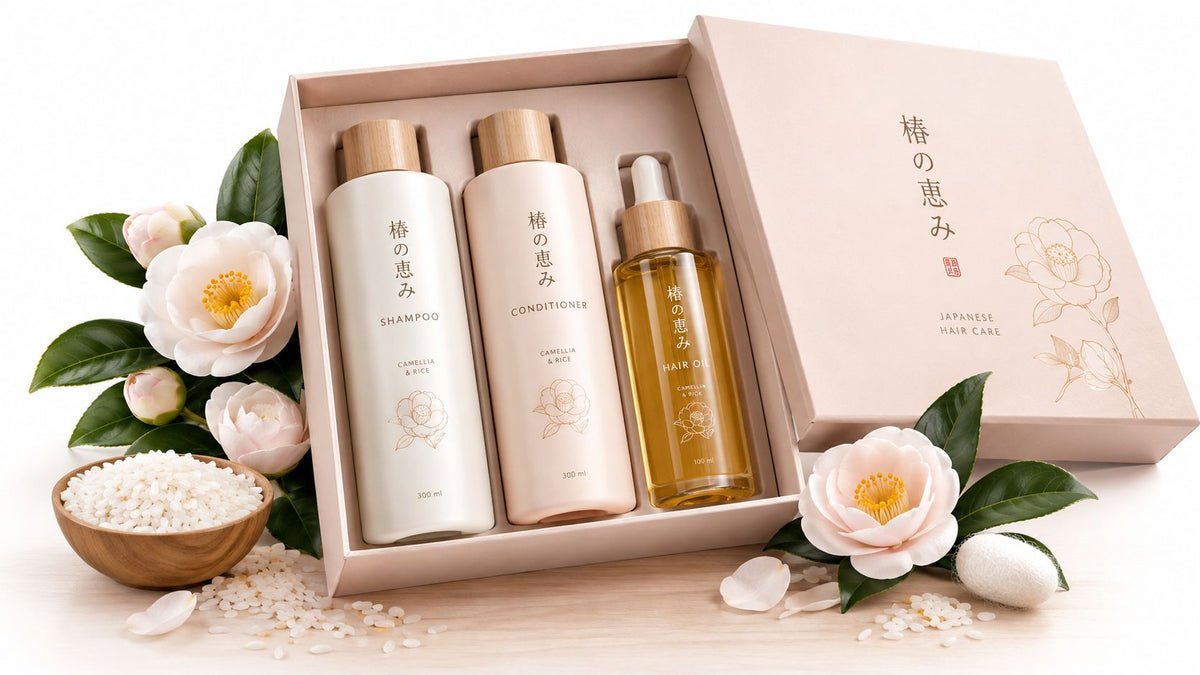
The most popular advice about Japanese products for glossy hair is also the least useful: buy camellia oil and expect a glass-like finish. Oil can make hair look shiny, but it can just as easily leave fine strands flat, greasy, or difficult to cleanse. The better question is not “Which ingredient creates shine?” but “Which product smooths this person's hair surface without creating buildup?”
That distinction matters when you're choosing a thoughtful Japanese beauty gift. A recipient with thick, weathered hair may appreciate a rich treatment and a finishing oil. Someone with fine, low-porosity hair may get more use from a lightweight conditioner or rinse-out mask. Japanese hair care offers both traditional ingredients and advanced film-forming formulas, but the right gift depends on how those products behave on the recipient's actual hair.
The Science Behind Japanese Hair Shine
Glossy hair is primarily a surface-physics problem, not merely a moisture problem. Hair looks bright when its outer surface reflects light in a relatively uniform direction. When the cuticle is lifted, cracked, or uneven, light scatters in multiple directions, making the hair appear rough and dull.
Hair weathering can remove the cuticle's hydrophobic 18-methyl eicosanoic acid layer, commonly called 18-MEA. As that protective layer wears away, the fiber becomes more hydrophilic, swelling and creating greater friction between neighboring strands. The result is familiar: more tangling, frizz, roughness, and less even reflection. The relationship between conditioning, friction, and shine is explained in this scientific review of hair conditioners and surface properties.
Why heavy oil isn't automatically better
A botanical oil can lubricate the surface and temporarily increase reflected light. That visual improvement is real, but it doesn't necessarily mean the cuticle has become uniformly smooth. Too much oil may also attract residue, reduce movement, and make hair appear dull once dust and product layers accumulate.
Effective conditioners use a more targeted approach. Cationic ingredients, lipids, silicones, and film-forming polymers are attracted to damaged regions of the hair, which tend to carry a negative charge. They deposit across cuticle fissures, help flatten lifted scales, and reduce fiber-to-fiber friction.
That is why a Japanese conditioner, mask, or leave-in with a proper conditioning deposition system can outperform a bottle of pure oil for everyday gloss. The formula doesn't just coat the hair with shine. It helps create a smoother surface that reflects light more evenly while making combing and styling easier. A practical guide to choosing and using these products appears in this resource on Japanese hair conditioner.
Practical rule: Choose the lightest formula that smooths the hair consistently. Shine should feel polished, not oily.
For gifting, look for a product that supports cuticle smoothing and friction reduction rather than one that relies only on words such as “moisture,” “silky,” or “gloss.” The most convincing result is repeatable improvement in feel, manageability, and surface reflection after several washes, not a brief greasy sheen immediately after application.
Heritage Ingredients for a Glass-Like Finish
Japanese haircare traditions offer more than attractive packaging. They also provide a useful way to curate gifts around surface condition, cultural meaning, and controlled use. Camellia oil and rice-derived ingredients are best presented as conditioning and surface-care ingredients, not guaranteed growth treatments.
Camellia oil and the language of tsubaki
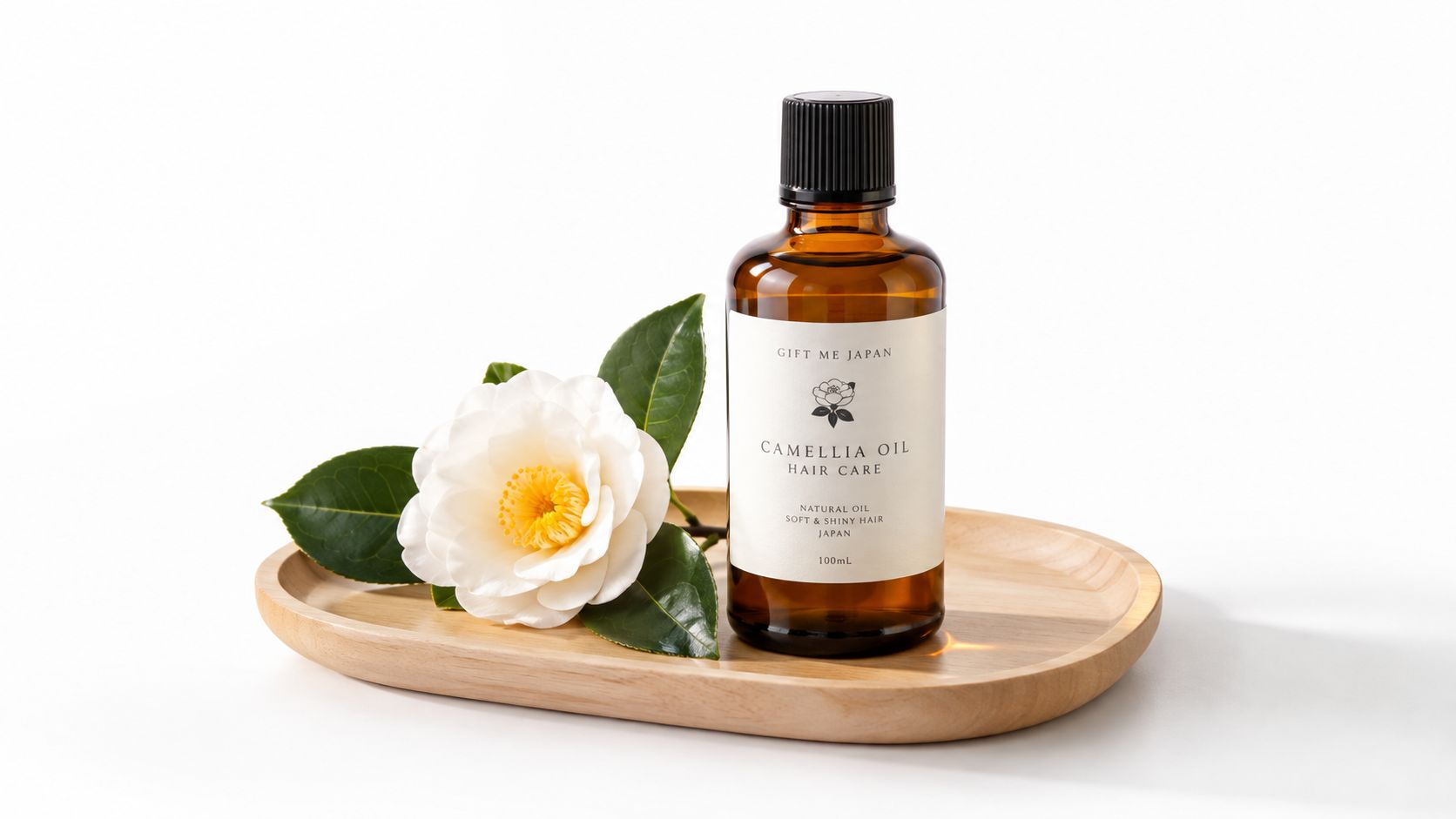
Camellia oil, known in Japan as tsubaki oil, has been associated with hair grooming since at least the Heian period, from 794 to 1185 CE. Historical accounts connect it with the long, dark hair associated with court women. Its use continued during the Edo period, from 1603 to 1868, when the oil became commercially available across social classes. Geisha and kabuki performers also used it for styling and personal care. These details appear in this Japanese beauty ingredients glossary.
Camellia oil contains approximately 85% oleic acid, according to a fatty-acid composition analysis. Oleic acid is a monounsaturated fatty acid also found in human sebum. This composition helps explain why camellia oil works as a relatively lightweight emollient. Applied sparingly, it can soften a dry-looking surface, improve lubrication, and increase visible sheen without the stiffness of some heavier waxes.
Its limitation matters just as much as its appeal. Camellia oil conditions the surface, but its history does not prove that it stimulates hair growth. Give it as a refined finishing or conditioning oil, particularly to someone who enjoys traditional Japanese beauty rituals.
Rice water and rice protein
During Japan's Heian period, court women reportedly used yu-su-ru, the water left after washing rice, while combing their hair. Modern cosmetic interpretation should remain narrower. Rice water may reduce surface friction and improve manageability, helping strands look smoother and potentially reducing mechanical stress. Ordinary homemade rice water has not been established as a treatment that stimulates new hair growth, and a clinical review has described the broader evidence as insufficient.
Commercial rice-derived formulas offer more consistent composition and application. Hydrolyzed rice protein has smaller molecules, while cationized rice protein is more likely to attach to the negatively charged surface of damaged hair. A Japanese ingredient supplier describes cocodimonium hydroxypropyl hydrolyzed rice protein as forming a thin, glossy, durable, water-resistant film with conditioning, shine, moisture-retention, color-protection, and antistatic functions. That profile makes rice protein a sensible choice for masks and leave-in treatments.
Rice protein still needs accurate positioning. It can temporarily smooth irregularities, reduce static, and improve light reflection, but it does not demonstrate permanent fiber repair. Choose a rice-inspired gift for someone who values Japanese traditions and wants softer, more manageable-looking hair. For unruly lengths, this guide to Japanese hair oil for frizzy hair can help you select a lighter or richer finish.
Matching Product Categories to Hair Types
A shampoo, mask, serum, and oil can all support glossy hair, but they don't solve the same problem. Gifting by ingredient alone is a mistake. The recipient's strand thickness, porosity, oil production, and styling habits determine whether a rich formula feels luxurious or burdensome.
High-porosity hair, often affected by bleaching, coloring, heat, or repeated weathering, usually tolerates more conditioning material. Fine, low-porosity hair often needs a smaller amount of film-forming product because its surface can become coated quickly. An oily scalp also changes the equation. A nourishing product may work beautifully on the ends while making the roots feel heavy.
A practical decision matrix
| Hair Type | Best Product Category | Key Ingredient Focus | Application Tip |
|---|---|---|---|
| Thick, dry, high-porosity hair | Treatment mask followed by a small amount of oil | Cationic conditioners, lipids, hydrolyzed rice protein, camellia oil | Apply from mid-lengths to ends and rinse the mask thoroughly |
| Fine, low-porosity hair | Lightweight conditioner or leave-in serum | Light film formers, modest conditioning agents, lightweight rice-derived ingredients | Start with a small amount and keep product away from the roots |
| Frizzy, weathered hair | Smoothing mask or leave-in treatment | Film-forming polymers, cationic ingredients, rice protein, selected oils | Use on damp lengths, then add only a trace of oil to dry ends |
| Oily scalp with dry ends | Gentle shampoo plus ends-focused conditioner | Mild cleansing system, light conditioning ingredients | Cleanse the scalp carefully and condition only the lower lengths |
| Coarse hair exposed to heat styling | Rich mask with a finishing oil | Lipids, emollients, film formers, camellia oil | Use the mask regularly enough to improve manageability, without layering oil daily |
| Hair that is easily weighed down | Rinse-out conditioner rather than pure oil | Lightweight conditioning deposition system | Rinse completely and assess the hair after it dries |
Shampoo is the safest category when you know little about the recipient's texture, but it can deliver less immediate change than a treatment. A mask makes a stronger gift for someone with visibly dry or processed hair. A leave-in serum suits recipients who style frequently and want controlled shine without the ritual of a heavier oil.
Pure camellia oil is the most personal choice. It can be elegant for someone who already enjoys oils, but it isn't the category I'd choose blindly for fine hair or an oily scalp. The trade-off is simple: the more coating a product leaves behind, the more carefully the recipient needs to control dosage and cleansing.
Watch this demonstration before pairing products in a routine:
For broader category ideas, use this guide to the best Japanese haircare products, then narrow the choice by the recipient's hair behavior rather than by packaging or ingredient popularity.
Building a Routine for Lasting Gloss
A single bottle rarely creates a coherent result. Gloss becomes easier to maintain when cleansing, conditioning, and finishing products each perform a defined task. The routine should also leave enough room for the recipient's hair to move naturally.
The order matters
- Cleanse the scalp, not the lengths. Work shampoo primarily into the scalp and let the lather pass through the lengths during rinsing. Scrubbing the ends adds friction where the hair is already most vulnerable.
- Condition from mid-lengths to ends. Damaged regions tend to carry more negative charge, so conditioning ingredients deposit more readily there. Keep heavier products away from the roots unless the label specifically directs otherwise.
- Use a mask selectively. A mask can be useful for thick, dry, or weathered hair. Fine hair may need it less often, or may prefer a shorter contact time and a smaller amount.
- Rinse completely. Residue can create the opposite of the intended effect, leaving hair limp, coated, or visually dull. Thorough rinsing is part of the shine routine, not an afterthought.
- Finish with restraint. Apply a leave-in serum or oil to damp lengths, then reassess after drying. If the ends still look rough, add a minimal amount rather than coating the entire head.
A simple two-week gift routine
For the first week, use the shampoo and conditioner consistently, with the conditioner focused on the lower lengths. Add a rice-protein treatment only if the hair feels porous, weak, or difficult to detangle. During the second week, compare softness, static, combing ease, and visible reflection rather than judging the result immediately after one application.
Protein-rich treatments can make some hair feel firmer and more controlled, but too much protein or film buildup may create stiffness or dullness. Alternate a protein-focused treatment with a lightweight conditioning product when the hair starts feeling rigid. This article on how to use ReFa hair oil can help recipients understand how to place an oil into a routine without overapplying it.
Gift note: Include a small routine card with the order of use. It turns a collection of attractive products into something the recipient can use confidently.
Curating Thoughtful Japanese Beauty Gifts
A good haircare gift communicates observation. It says you noticed that the recipient enjoys careful rituals, polished styling, traditional ingredients, or practical self-care. That is more meaningful than choosing the most decorated bottle on the shelf.
For a birthday, a compact pairing of a smoothing conditioner and a finishing oil can suit someone who already has a basic shampoo routine. For a graduation, a gentle shampoo with a leave-in treatment creates a useful daily ritual without assuming that the recipient wants an elaborate beauty regimen. A corporate or team gift should stay broadly usable, favoring rinse-out products and moderate textures over highly specific scalp or treatment claims.
Match the set to the person
- For someone with thick or dry hair: Pair a treatment mask with a small amount of camellia oil. The mask provides conditioning support, while the oil adds controlled surface lubrication and shine.
- For someone with fine hair: Choose a lightweight conditioner or leave-in serum. Avoid building the gift around a large amount of pure oil, which may be harder to dose successfully.
- For a ritual-focused recipient: Select rice-derived or camellia-based products and explain the historical connection briefly. The cultural story adds meaning, but the product description should remain focused on conditioning and manageability.
- For a styling enthusiast: A leave-in treatment is often more useful than a rinse-out mask alone. It can fit into blow-drying, brushing, or finishing habits without requiring a new weekly ritual.
- For a broader self-care present: Combine one hair product with complementary skincare or lifestyle items rather than stacking several products that perform nearly the same function.
The strongest assortment has contrast without confusion. A shampoo cleanses, a conditioner smooths, a mask intensifies care, and an oil or serum finishes. If every item is rich and film-forming, the set may look generous but become impractical. If every item is lightweight, someone with coarse or damaged hair may find the result underpowered.
Presentation also matters. Check the current product listing for exact contents, sizes, variants, and packaging before describing a set to the recipient. Don't promise gift wrapping, a message card, accessories, or a particular box unless the listing confirms them. A carefully chosen Japanese gift set should feel intentional because the items work together, not because it contains the largest possible number of products.
Ensuring Authenticity and Sourcing Quality
Authenticity is part of the gift. International shoppers need more than attractive packaging. They need confidence that the product name, ingredient information, formulation, and handling match the item they intended to send.
Direct sourcing from Japan reduces uncertainty around origin and helps preserve access to accurate labeling. It also makes the shopping experience easier to audit. A trustworthy retailer should identify the product clearly, show the relevant variant, explain current availability, and publish practical information about shipping, returns, privacy, and customer support.
What to verify before ordering
- Product identity: Confirm the exact name, brand, variant, and format. Similar packaging can hide meaningful differences between a shampoo, treatment, refill, and styling product.
- Current contents: Check the live listing for the included items, quantities, sizes, and packaging. Don't rely on an old photograph or a search result that may no longer reflect the assortment.
- Ingredient information: Read the current label and product description, especially when the recipient has allergies, fragrance sensitivities, or a preference for particular textures.
- Delivery information: Review destination rules, shipping terms, tracking availability, and any stated delivery estimates before buying. A retailer cannot guarantee arrival before an occasion unless its current delivery information supports that promise.
- Checkout security: Use a store with a clear checkout flow and recognizable payment options. A unified storefront, visible policies, and an order-tracking route give both buyer and recipient a clearer record of the purchase.
A curated store has a practical advantage over scattered marketplace listings. It brings products into one consistent retail environment, reduces comparison fatigue, and makes it easier to assemble a coherent gift around hair type or occasion. That doesn't remove the need to read the product page. It makes the checking process more manageable.
For beauty gifts, authenticity also means resisting dramatic claims. A legitimate hair product may improve softness, lubrication, manageability, or visible shine. Those cosmetic effects shouldn't be presented as follicle treatment, permanent repair, or a cure for hair loss.
Common Questions About Japanese Haircare Gifts
Will the hair look glossy immediately?
It may look smoother after the first use, especially if the product deposits conditioning ingredients across rough cuticle areas. Immediate shine can also come from a surface coating, so judge the gift by how the hair feels and behaves after repeated washes. Gloss should not depend on leaving a heavy, greasy layer behind.
Is rice water a hair-growth treatment?
No. Traditional yu-su-ru has a documented connection with Japanese hair care, and rice-derived products may support manageability and surface smoothness. A rice-bran formulation studied in a human trial involved 50 Korean patients with alopecia, who used either the formulation or a placebo twice daily for 16 weeks, and the rice-bran group reportedly showed greater hair density and increased hair diameter by the study's end, as summarized in this report on rice water and hair research. That specific preparation shouldn't be generalized to homemade rice water or every Japanese rice product.
Can rice protein repair damaged hair permanently?
No. Hydrolyzed or cationized rice protein can form a substantive film that smooths the surface, reduces static, and improves shine. Treat it as temporary surface conditioning, not proof that the internal fiber has been permanently restored.
How should recipients manage allergies or sensitivities?
Encourage the recipient to check the current packaging and ingredient label before use. Patch testing is sensible for beauty products, particularly when the recipient has a history of sensitivity. Don't describe a product as suitable for a particular allergy, diet, or medical condition unless the current product information confirms it.
What should I check about international delivery?
Review the retailer's current shipping policy, destination availability, stated rates, delivery estimates, and tracking process before ordering. Delivery timing can change by destination and season, so don't promise that a gift will arrive by a specific holiday unless the current information supports that expectation.
What if the recipient has hair loss?
A glossy finish and a hair-growth treatment are different objectives. Japanese haircare gifts can support cosmetic conditioning and styling, but persistent or concerning hair loss calls for advice from a qualified healthcare professional rather than a promise from shampoo, oil, or rice water.
Choose the gift according to the recipient's hair texture, routine, and interest in Japanese beauty traditions. A small, well-matched set is more thoughtful than a large assortment that creates buildup or leaves the recipient unsure where to begin.
Gift Me Japan offers carefully curated Japanese gift sets and beauty products sourced directly from Japan, with options that combine traditional ingredients, modern care, lifestyle goods, and Japanese snacks. Visit Gift Me Japan to explore a haircare-focused present or a broader Japanese gift set suited to your recipient and occasion.


Share:
Japanese Heat-Protection Hair Products: A Practical Guide