

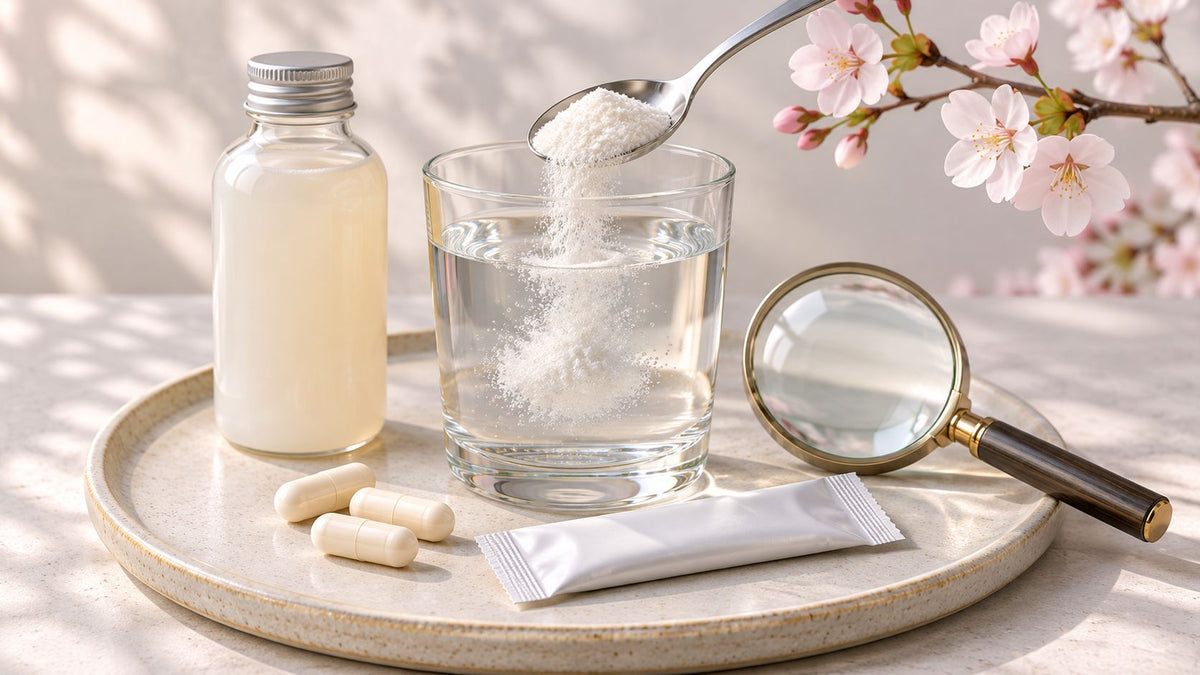
Buying collagen because it comes from Japan isn't enough to choose well. Japanese provenance can help you understand a product's origin and labeling context, but it doesn't tell you whether its daily serving matches a clinical trial, which skin outcomes were measured, or whether it suits the person receiving it.
For a thoughtful beauty gift, the better questions are practical: What's in the product, how would the recipient use it, and what does the evidence support? Those questions separate an attractive Japanese wellness purchase from an informed one.
What Japanese Collagen Means and Why Origin Matters
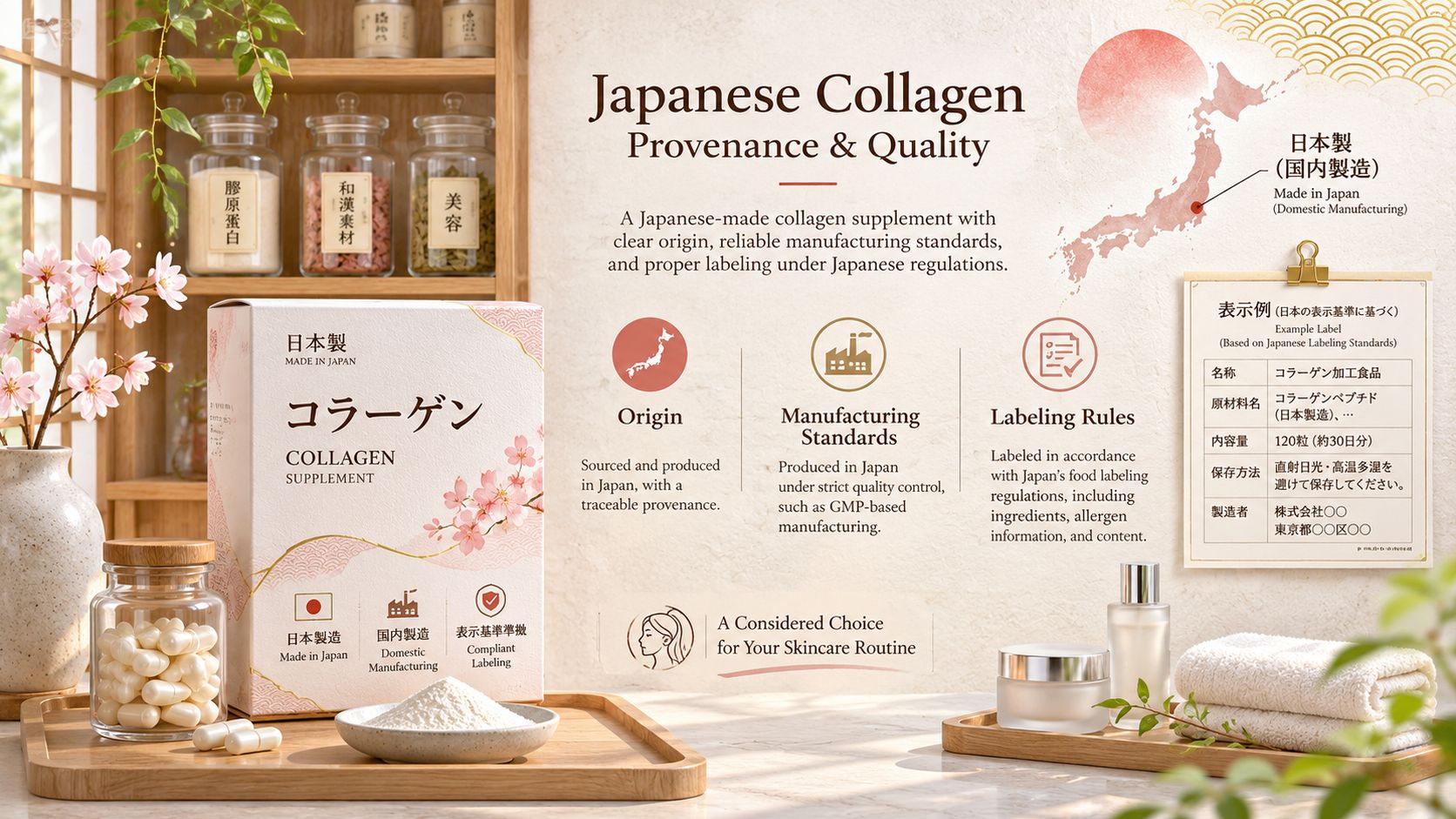
Collagen from Japan describes provenance, not a guaranteed result. It generally means a product is made or sourced in Japan, although shoppers should distinguish the finished product's manufacturing location from the origin of its collagen ingredient. A Japanese brand name alone doesn't answer both questions.
Collagen is a structural protein found in skin, bones, and connective tissue. Consumer supplements commonly use hydrolyzed collagen, meaning collagen broken into smaller fragments called peptides, rather than intact collagen protein.
What origin can tell you
Think of a recipe written in Japanese: it can tell you something about the dish's background, but not whether you'll enjoy eating it. Similarly, Japanese packaging provides context, not proof that a formulation will outperform another product.
Japan has an established collagen category spanning supplements, drinks, powders, and functional foods, as described in IMARC Group's Japan collagen market overview. That variety helps explain why collagen appears alongside skincare and everyday wellness products, but commercial popularity isn't clinical evidence.
The packaging is a useful starting point for checking what a product contains.
What still needs verification
Japanese collagen is often associated with marine or fish-derived ingredients. However, marine, Japanese-made, and clinically tested are different descriptions. Each needs its own supporting information.
Before choosing, separate these questions:
- Finished-product origin: Where was the supplement or food manufactured?
- Ingredient identity: What animal source and collagen preparation does it contain?
- Evidence relevance: Does the finished formulation resemble the preparation studied?
- Practical suitability: Can the recipient comfortably follow the instructions?
For shoppers exploring distinctive gifts made in Japan, that distinction matters. Authentic origin can make a gift meaningful without making it medically superior.
Buying principle: Treat Japanese origin as a reason to investigate a product, not as the evidence that it works.
The useful decision comes down to delivery format, a clearly stated daily amount, and understandable labeling. Beautiful presentation can support the gifting experience, but it can't replace those checks.
Collagen Formats Compared Side by Side
Collagen formats and what to check on the label
| Format | Typical form | How it is taken | What to check on the label |
|---|---|---|---|
| Powder sachet or stick | Granules or powder | Measured and dissolved in water or a drink | Grams and milligrams of collagen peptides per serving |
| Ready-to-drink bottle | Liquid collagen drink | Commonly supplied as a unit serving; follow the stated daily directions | Milligrams of collagen peptides per bottle and serving count |
| Capsules or tablets | Swallowed capsules or tablets | Taken with water, in the number specified on the label | Milligrams per capsule and total daily amount |
| Chewable or gummy | Chewable piece | Chewed in the quantity specified on the label | Milligrams per piece, sugar content, and ingredient list |
| Functional food | Snack, bar, or food product | Eaten as food, using the stated serving amount | Milligrams per serving and any notified claim wording |
Compare milligrams per day, not package size or format appeal. The weight of a powder serving isn't necessarily the weight of its collagen peptides. Likewise, a prominent number on a bottle may describe the entire container rather than the amount the directions tell someone to consume.
Powders can suit someone who already prepares a daily drink and doesn't mind measuring or mixing. Individually portioned sticks remove the measuring step, although the recipient still needs to check preparation instructions and whether the flavor fits their routine.
Convenience needs to match the person
A ready-to-drink product avoids mixing, making the routine straightforward. Before gifting it, consider whether the recipient wants another flavored drink and whether the bottles are practical to store.
Capsules and tablets suit people who prefer swallowing a supplement to drinking it. The important detail is the full daily serving, not the amount in an individual capsule. Someone who dislikes taking several tablets may find an otherwise appealing product inconvenient.
Chewables and functional foods can feel more familiar than supplements, but their ingredient lists deserve equal attention. Flavorings, sweeteners, and accompanying food ingredients are part of the purchase, not incidental details.
- For a drink-making routine: Prioritize clear mixing directions and an acceptable flavor.
- For minimal preparation: Consider a clearly portioned format that requires little handling.
- For someone who dislikes sweet products: Read the ingredient list rather than assuming a capsule or powder is unsweetened.
- For food-oriented gifting: Confirm that the recipient wants a collagen-containing food, rather than treating it as an ordinary snack surprise.
A format tells you how collagen is delivered, not what it will achieve. A pleasant routine makes consistent use more practical, but neither convenience nor attractive packaging establishes effectiveness.
Dose, Duration and Realistic Expectations
Daily dose and trial length in collagen studies
| Study group | Daily dose | Duration | Outcomes reported |
|---|---|---|---|
| Healthy Japanese women aged 35–50 | 1 g or 5 g | 12 weeks | Water content and natural-moisturizing-factor measurements improved; elasticity and thickness didn't significantly change in the Japanese trial. |
| Healthy women aged 30–60 using fish-scale peptides | 3,000 mg | 12 weeks | Periorbital wrinkles decreased, and facial moisture and elasticity improved versus placebo in the fish-scale collagen peptide trial. |
| 64 adults using low-molecular-weight collagen peptide | 1,000 mg | 12 weeks | Hydration, elasticity, and wrinkle-related measurements improved versus placebo in the low-molecular-weight peptide study. |
| Women over 40 with aging, wrinkled skin | 10 g | 56 days | Significant elasticity improvement versus placebo and no side effects were reported in the study described by this collagen evidence review. |
| 2025 placebo-controlled study of women aged 45–60 | 2.5 g | Not stated in the available study summary | Firmness and elasticity improved significantly; hydration didn't improve significantly, as described in this review of oral collagen evidence. |
These are benchmarks, not interchangeable prescriptions. Each row describes a particular preparation, participant group, and set of measurements. The table doesn't establish that an unrelated drink or powder will reproduce those results.
Read the outcomes separately
The Japanese trial in the opening row is especially useful because its results weren't uniformly positive. Improved moisture-related measurements didn't coincide with significant changes in elasticity or thickness. That's a reason to ask what a product's supporting study measured, rather than accepting a broad anti-aging description.
The fish-scale peptide trial reported benefits across several skin measurements. However, it tested a defined ingredient under controlled conditions, not Japanese collagen as an entire category. Its findings support investigating a comparable preparation, not assuming every fish-derived product behaves identically.
The low-molecular-weight study provides another example of a measured daily serving producing favorable results. It doesn't establish a universal minimum effective dose, and it doesn't show that molecular weight alone determines the outcome.
The higher-dose trial described in the evidence review reported elasticity benefits. That result isn't a reason to increase a product's serving beyond its directions: the trials weren't a direct contest to identify the largest useful dose.
Finally, the later placebo-controlled study reported improvements in firmness and elasticity without a significant hydration improvement. Its duration isn't stated in the available summary, so it can't supply a complete dose-and-duration benchmark.
A favorable result for hydration isn't proof of wrinkle reduction. A favorable result for elasticity isn't proof of lifting.
Ingredient composition also matters
A randomized study comparing collagen hydrolysates found greater improvements in moisture, elasticity, wrinkles, and roughness with a formulation containing higher concentrations of the peptides Pro-Hyp and Hyp-Gly than with a lower-bioactive formulation or placebo.
The practical implication is that total collagen mass doesn't describe the whole formulation. If a seller invokes clinical evidence, look for the tested ingredient's identity and composition, not just a matching word on the front label.
Across the evidence, hydration and elasticity are more defensible expectations than sweeping structural anti-aging promises. The reviewed studies were concentrated in East Asia, including Japan, which also limits how confidently shoppers can generalize the findings to every recipient.
A measured way to assess a routine
- Use the labeled serving. Don't increase it to imitate a different trial.
- Keep other skincare stable. Changing several products together makes personal observations difficult to interpret.
- Allow a sustained observation period. The trials above evaluated repeated use over weeks, not an immediate cosmetic response.
- Record specific observations. Note dryness or perceived suppleness rather than expecting a general transformation.
- Patch test topical cosmetics separately. Oral supplement evidence doesn't establish how a cream will perform on your skin.
The distinction between ingestible collagen and topical skincare matters when viewing a cosmetic product.
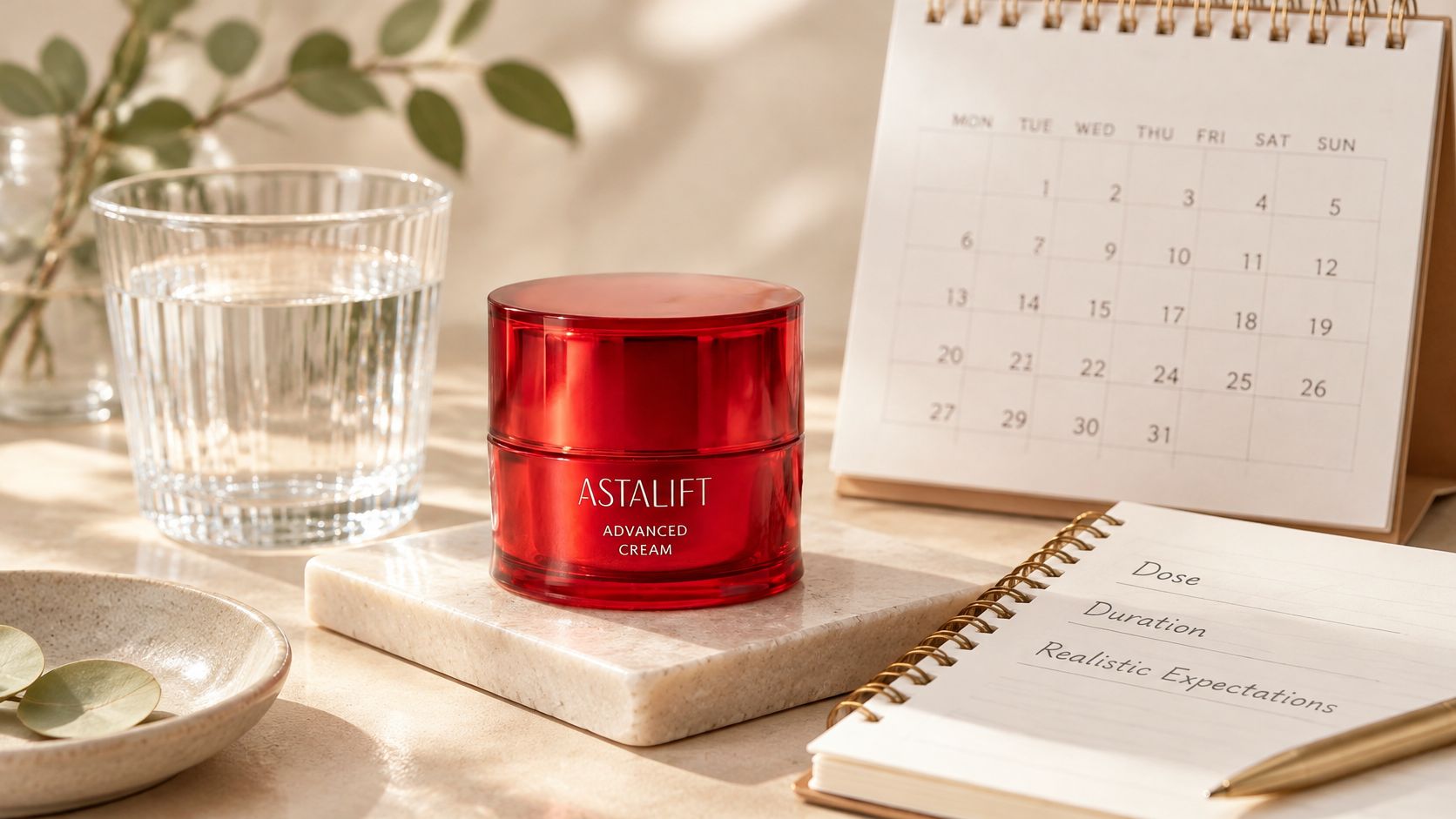
A cream belongs to a topical routine, not to the oral-dose comparisons in the table. For help organizing that separate routine, use the Japanese skincare routine for beginners.
Collagen supplements shouldn't be presented as treatment for a skin condition. Persistent or troubling skin changes deserve advice from a qualified professional.
Reading Claim Categories and Japanese Labels
Japanese claim categories and what each allows
| Category | What it may say | What to check |
|---|---|---|
| Ordinary health food | Nutrition information; efficacy claims aren't freely permitted | Collagen amounts per serving and per day, plus the ingredient list |
| Foods with Function Claims | Limited claims supported by scientific evidence notified to the Consumer Affairs Agency | Exact notified claim wording and the stated daily amount |
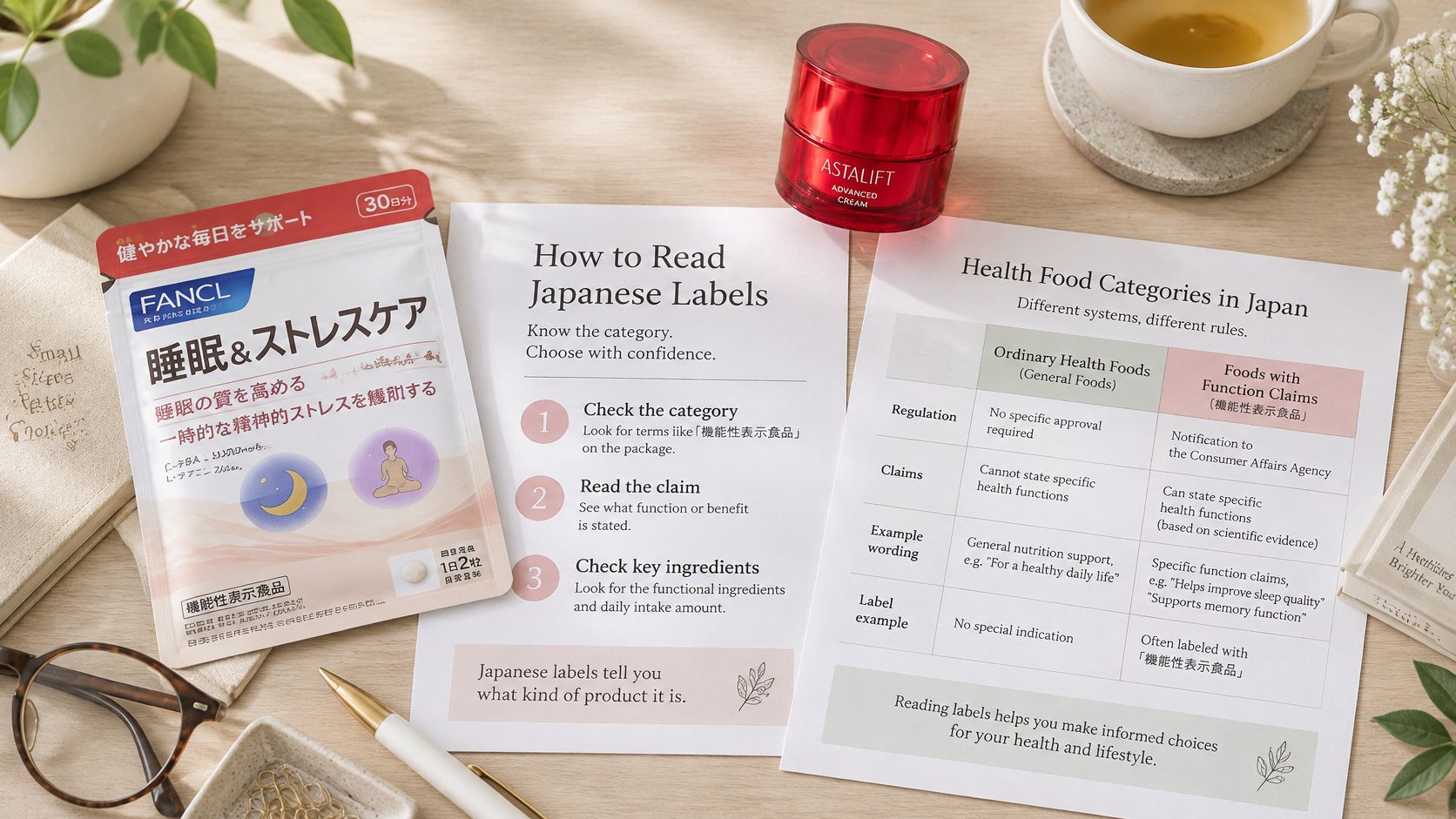
The Japan Health Food and Nutrition Food Association's collagen guidance explains that ordinary health foods cannot freely make efficacy claims under Japan's Health Promotion Act, while Foods with Function Claims may carry limited claims when scientific evidence is notified to the Consumer Affairs Agency. The same guidance calls for collagen peptide or hydrolyzed-collagen quantities to be stated in milligrams for the serving and daily amount.
Use the packaging to identify the product category before interpreting its beauty language.
A shelf-side reading sequence
- Find the collagen quantity. Separate the peptide amount from the total weight of the food, powder, or drink. Check both the serving quantity and the complete daily directions.
- Identify the product type. Decide whether you're reading a supplement, a food, a functional-claim product, or a topical cosmetic. Their labels don't communicate the same thing.
- Read the supporting ingredients. Review sweeteners, flavorings, and additives against the recipient's preferences rather than treating the headline ingredient as the entire formula.
- Check date and batch information. Keep ingestible-product date instructions distinct from cosmetic batch coding.
- Make sure the instructions are usable. The recipient needs to understand preparation, quantity, storage, and relevant cautions.
Our products are manufactured for the Japanese market and sold in accordance with applicable Japanese standards. Formulations, permitted ingredients, usage instructions, and labeling requirements may differ between Japan and your country.
Many products are made for the Japanese domestic market, so packaging and printed instructions may be primarily in Japanese. We provide English product information where available, but shoppers should still check the current packaging and ingredient label.
Keep cosmetics and health foods separate
Japanese cosmetics often use a production or batch code instead of a printed expiry date. Don't assume an unfamiliar code on a cream has the same meaning as a date instruction on a collagen drink.
That category distinction is also useful when evaluating other beauty purchases, including Japanese eyelash serums. A cosmetic's appearance or Japanese origin doesn't place it within a food-claim system.
The following video offers an additional visual reference alongside these label checks.
Label check: Read the permitted claim as written. Don't expand a narrow statement into a promise about every visible sign of aging.
First identify the category, then verify the status of the specific claim. If you can't connect the wording to a substantiated, notified claim, don't treat it as one merely because it sounds scientific.
Matching Collagen to the Person Who Will Use It
Start with the source and allergy check, not the occasion. Fish-derived collagen is unsuitable for someone with a fish allergy, while bovine and porcine sources raise different dietary considerations. An appealing marine label doesn't make a product universally suitable.
Read the source declaration and the complete ingredient list, including accompanying food ingredients. Customers with a serious allergy should contact us at Gift Me Japan before ordering.
Suitability comes before surprise
Don't assume halal, kosher, vegetarian, vegan, or gluten-free suitability from the country of origin or product format. Confirm any relevant designation in the current packaging or product information, and don't substitute a shopper's inference for an explicit statement.
The clinical examples also come from particular adult populations, largely women. Their findings shouldn't automatically be extended to teenagers, men, or people with unrelated skin concerns. Someone who is pregnant, has a medical condition, or takes regular medication should speak with a qualified clinician before starting a supplement.
For gifting, the recipient's consent matters too. A collagen supplement can feel thoughtful to someone who already enjoys ingestible beauty products, but intrusive to someone who hasn't expressed that interest.
- Existing supplement users: Ask which format and ingredients they already prefer before choosing a birthday or thank-you gift.
- Skincare enthusiasts: Consider whether they want an ingestible product at all, rather than assuming interest in creams extends to supplements.
- Food-focused recipients: Check that a functional food's collagen ingredient fits their diet and that its flavor appeals to them.
- Recipients with unclear preferences: Choose a different gift category instead of guessing about a daily supplement.
Match the routine before the budget
A person who makes a morning drink may welcome a mixing step; someone who travels frequently may prefer fewer preparation tasks. Let their existing habits guide the format rather than asking them to adopt an unfamiliar routine for your gift.
Only then consider the occasion and spending limit. Compare what the recipient will use, and don't assume a purchase includes wrapping, a message card, or additional items unless the listing confirms them.
For someone who prefers topical beauty care, the guide to choosing Japanese skincare products offers a different starting point. Keep the gift focused on the recipient's interests, not an implied need to look younger.
Choose a Collagen Product You Can Verify
A convincing collagen purchase should be understandable without relying on a country-of-origin story. You should be able to identify the ingredient, explain the serving directions, and distinguish the product's actual claim from the expectations created by its packaging.
Before ordering, make a compact decision record:
- Routine fit: The recipient wants this product type and can follow its directions comfortably.
- Evidence fit: The stated preparation and daily amount can be compared meaningfully with clinical benchmarks.
- Label clarity: The claim category, source species, ingredients, and cautions are understandable.
- Gift readiness: The listing clearly identifies what's included, without assumed extras or packaging.
Authenticity and suitability are separate checks
A genuine Japanese product can still be the wrong gift for a particular person. Conversely, a modestly presented item with transparent instructions may suit them better than an elaborate wellness purchase.
Use the same care when choosing authentic Japanese gifts online: verify origin, then assess the actual contents against the recipient's needs. Before ordering, check current ingredient information, packaging details, availability, and destination-specific delivery information rather than relying on an older description.
Choose for compatibility first, evidence second, and presentation third. If the source, serving instructions, or claim category remains unclear, leave that product out of the gift.
Gift Me Japan offers curated skincare selections and Japanese gift sets combining skincare, beauty, and lifestyle essentials sourced directly from Japan, alongside Japanese snacks and items reflecting traditional and modern Japanese interests. Visit Gift Me Japan to explore options that fit your recipient's routine, and check each listing's ingredients and contents before choosing a beauty or wellness gift.
Share:
White Kojic Acid Soap: What It Is and How to Use It Safely
Nori Tama Furikake: Flavor, Origin and Ways to Serve