

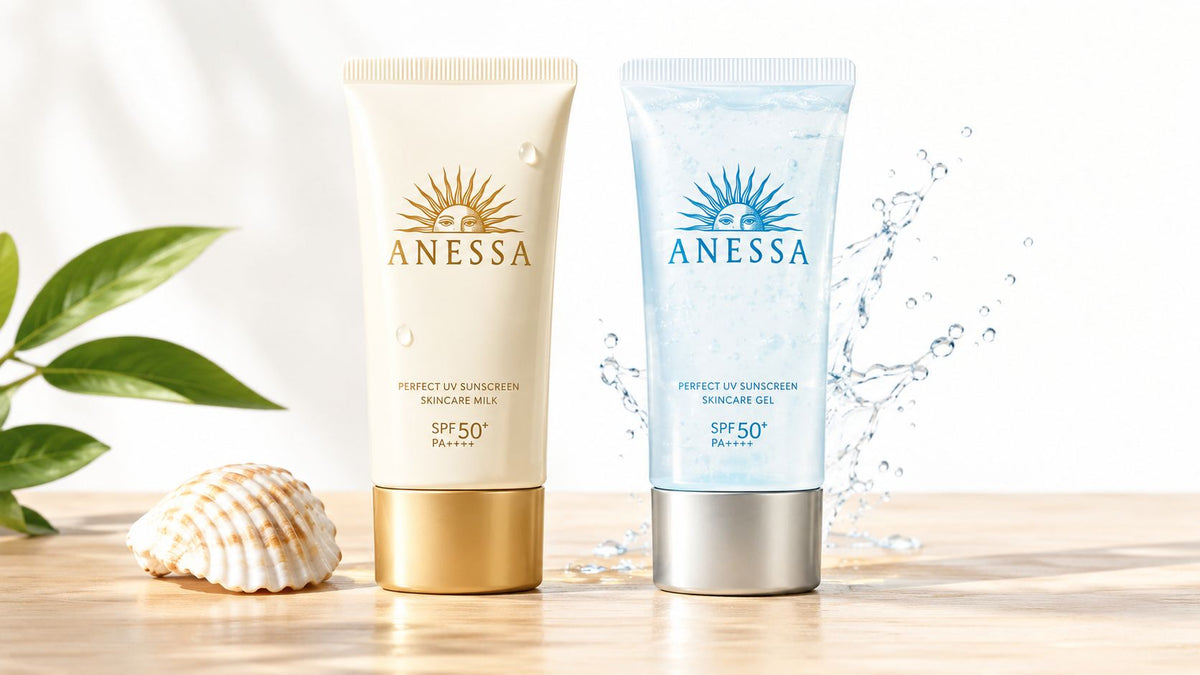
A drugstore shelf can make the choice look strangely difficult. The Anessa Perfect UV Skincare Milk and Anessa Perfect UV Gel both carry the familiar SPF50+ PA++++ label, yet one feels like a fluid milk and the other feels closer to a moisturising gel. If you're choosing a Japanese sunscreen for yourself or as a thoughtful beauty gift, the important question isn't which bottle has the more impressive label. It's which one fits the recipient's climate, routine, makeup habits, and tolerance for a more tenacious finish.
Anessa has been Shiseido's leading suncare brand in Asia, with a history that began in 1992. Shiseido says the brand is sold in 11 Asian countries and regions, with current sales of approximately JPY 50 billion. Japan represents about 30% of total sales, while overseas markets contribute about 70%, making this milk-versus-gel distinction relevant to shoppers far beyond Japan. (Shiseido's ANESSA brand overview)
Two Bottles, One Question
You're standing in a beauty shop with two Anessa bottles in your hand. The labels appear to promise the same high level of UV protection, but the milk looks like the serious outdoor option and the gel seems easier to imagine using every morning. You may be buying for a beach holiday, a daily commute, or an international gift, and the packaging alone doesn't tell you which format will feel right after several hours on skin.
The two products answer different practical needs. The Perfect UV Skincare Milk is the more resistant, outdoor-oriented format, while the Perfect UV Gel focuses on spreadability, moisture, and daily comfort. Both sit within a brand that Shiseido describes as a specialist line built on a long sunscreen research heritage, so this isn't a comparison between a high-protection product and a casual moisturiser. It's a choice between two ways of wearing high-protection sunscreen.
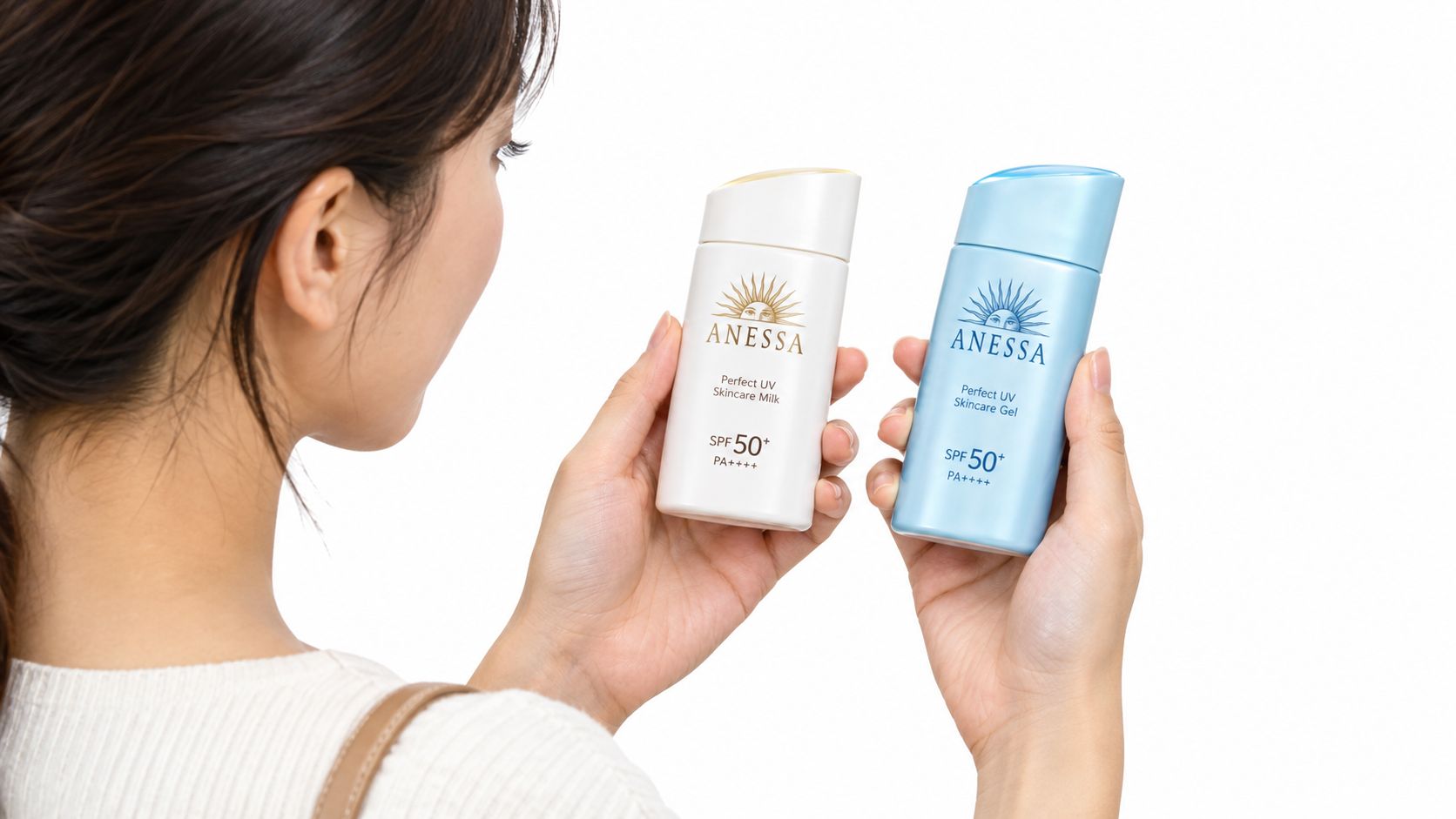
A useful starting point is to ignore the common shortcut of “gel for oily skin, milk for dry skin.” Skin type matters, but it doesn't decide everything. A person with dry skin may still prefer the milk for a long outdoor day, while someone with combination skin may choose the gel for a humid commute and the milk for a weekend hike.
| Criterion | Perfect UV Gel | Perfect UV Skincare Milk |
|---|---|---|
| Protection label | SPF50+ PA++++ | SPF50+ PA++++ |
| Main strength | Comfortable daily texture | Higher resistance for outdoor wear |
| Finish | Hydrated and slightly dewy | Softer matte, smoother, more primer-like |
| Best setting | Commute, office, makeup, humid weather | Beach, sport, long outdoor exposure |
| Main trade-off | Less suited to heavy water and sweat exposure | Can feel more substantial or drying |
The rest of the decision comes down to texture, finish, water resistance, layering, and removal. If you want one sunscreen for an ordinary weekday, the gel may be the more dependable habit-former. If you need a film that stays in place through water, sweat, and friction, the milk deserves priority. There isn't a universally better format. There is only a better match for the day ahead.
For a broader introduction to Japanese sunscreen formats, see this Anessa sunscreen guide.
What SPF, PA, and Water Resistance Really Mean
The shared label tells you that both formats are designed to provide strong broad-spectrum protection, but it doesn't describe how they behave on skin. SPF relates primarily to protection against UVB, the radiation associated with sunburn. PA describes UVA protection, which is relevant to tanning, photoageing, and the darkening of existing pigmentation.
In Japan, PA++++ is the highest commonly used PA grade. Both the milk and gel are sold in the Japanese market with SPF50+ PA++++, so protection on the label isn't the deciding factor between these two formats. The difference appears after application, when the formulas create different films and respond differently to sweat, water, rubbing, and makeup.
Read the label in two layers: SPF and PA describe the level of UV protection. Texture and water resistance describe how easily you can keep that protection on your skin.
Water resistance is a separate consideration. It indicates how well a sunscreen film withstands contact with water under a defined test, but it doesn't mean the product remains untouched after swimming, towelling, sweating heavily, or rubbing against clothing. A water-resistant product still needs sensible application and reapplication.
The Anessa milk is described with stronger water resistance, including testing reported at 80 minutes under ISO 18861:2020 standards. (Anessa Perfect UV Skincare Milk product information) That makes the milk the more convincing choice for swimming, beach use, and outdoor sport. The gel is better understood as a comfortable daily sunscreen rather than the automatic choice for prolonged water exposure.
Don't treat any rating as permission to apply less product. A high label can't compensate for a thin, patchy layer, missed areas around the ears and neck, or failure to reapply after substantial sun exposure. The product only protects the skin it covers, and real-life movement can disturb a sunscreen film even when the original formula is well designed.
For more context on choosing high-protection Japanese formulas, read this guide to Japanese sunscreen with SPF50.
Side by Side on Texture, Finish, and Wear
The most useful Anessa milk vs gel sunscreen comparison starts with the first few seconds after dispensing. The gel has a lightweight, water-gel character that spreads with a bouncy slip. It feels easy to distribute across the face without the drag associated with a thicker cream, then leaves a hydrated, close-to-invisible finish.
The milk is more fluid than its name may suggest. It has a thin lotion-like consistency, but it settles into a more cushioned film with a softly matte appearance. That film can feel more present on the face, which is exactly why it appeals to people who want a sunscreen that behaves like a smoothing base rather than disappearing completely.
| Criterion | Perfect UV Skincare Gel | Perfect UV Skincare Milk |
|---|---|---|
| Initial texture | Lightweight, bouncy gel with easy spreadability | Thin, fluid milk with more noticeable slip |
| Finish | Fresh, hydrated, slightly dewy | Softer matte and more smoothing |
| Humid weather | Usually feels lighter and less occlusive | Can feel more substantial |
| Dry indoor air | May need extra moisturising underneath | More cushioned on the skin |
| Makeup layering | Easy to place beneath foundation when applied evenly | Can give makeup a smoother base, but needs setting time |
| Friction | Lighter film may move more easily when rubbed | More tenacious feel, especially for outdoor use |
| Evening removal | Often straightforward with a thorough cleanse | May need more deliberate cleansing |
The gel generally makes more sense under makeup when you dislike a sunscreen that announces itself. It can leave foundation sitting on a smooth, hydrated surface, although too much rubbing during application can still disturb any sunscreen. The milk offers a more primer-like finish, particularly for people who like a soft-focus or powderier base, but it rewards patience before complexion products go on.
Midday comfort also depends on the room around you. In hot, humid weather, the gel's lighter film may feel less distracting. In dry, air-conditioned conditions, the milk's cushioned finish may feel more comfortable, especially if the skin has already been prepared with moisturiser.
Removal is another real trade-off. A lighter gel film may lift more easily during a normal evening cleanse. The milk's stronger outdoor positioning means you should take removal seriously rather than relying on a quick rinse. Use a cleanser suited to your routine, and cleanse carefully around the hairline, sides of the nose, and jaw.
Both formats are intended for facial use and are commonly described as light in fragrance while using an alcohol-based sunscreen style. If alcohol or fragrance tends to sting your skin, patch test before committing to regular use. The meaningful distinction isn't marketing drama. It's whether you prefer a lighter, more hydrated film or a more durable, softly matte one.
For related product-selection advice, explore these Japanese skincare products.
The Gel Format in Practice
The Anessa gel deserves to be judged as a complete daily sunscreen, not as a weaker version of the milk. Its appeal is immediate: the texture spreads quickly, feels light, and leaves little visible residue when applied evenly. Many users experience it as closer to a hydrating essence than to a traditional beach sunscreen, which makes the morning application easier to repeat.
That comfort matters on ordinary days. A gel is a strong fit for a commute, a mostly indoor office schedule, casual errands, and makeup routines where you don't want the sunscreen to compete with foundation. It also makes sense in hot, humid climates, where a richer film may feel distracting before the day has even started.
The gel's finish is usually hydrated rather than powdery. That can flatter normal, dry, and combination skin, but very dry skin may still want a moisturising layer underneath. A dewy finish can also look more noticeable on an oily T-zone, so allow the gel to settle before deciding whether you need a small amount of powder.
Where the gel reaches its limit
The same lightness that makes the gel pleasant for a commute isn't an advantage in every setting. For heavy sweating, swimming, beach time, and repeated towel contact, the milk is the safer format because it is positioned around stronger water and friction resistance. The gel may also shift more readily when clothing, hands, or a towel repeatedly rub the skin.
This doesn't make the gel unsuitable for summer. It means you should match it to the exposure. A hot walk between trains is different from an afternoon in the water, and an outdoor lunch is different from a full day of hiking.
Choose the gel when daily comfort, easy spreading, makeup compatibility, and a lighter feel will determine whether the wearer applies enough and uses it consistently. For a gift recipient whose skin type and finish preference you don't know, that approachable texture can be the less polarising option. Just don't present it as the outdoor specialist.
The Milk Format in Practice
The milk has a thinner, more fluid consistency than a rich cream, but it creates a more tenacious film than the gel. It settles with a softly matte, smoothing effect that explains its reputation as an outdoor staple. On some complexions, that finish looks polished and primer-like. On dry or flaky areas, it can make texture more visible.
Its central advantage is resistance. Anessa positions the milk as the format for stronger water and sweat exposure, and the milk's water-resistance testing has been reported at 80 minutes under ISO 18861:2020. (The milk's reported water-resistance testing) This is why I'd choose it for a beach day, outdoor sport, hiking, or any plan where the sunscreen needs to remain dependable through more than a quick trip outside.
The formula's durability is also its main compromise. A film designed to stay in place can feel drying or tight on dehydrated skin, particularly if the skin isn't prepared first. It can emphasise flakes around the mouth or nose, so apply moisturiser where needed and give it time to settle before judging the finish.
Who should choose the milk
The milk is for someone who values hold over weightlessness. It suits outdoor travellers, active recipients, people who prefer a softly matte base, and makeup wearers who like sunscreen to create a smoother surface beneath foundation. It also makes a practical face-and-body option when the day involves substantial outdoor exposure, provided the wearer is comfortable with the more noticeable film.
Don't remove it casually. Water alone isn't enough for a product chosen for its resistance, and an evening cleanse should cover the entire application area. If the recipient has sensitive or easily irritated skin, patch testing is sensible. The current Japanese Perfect UV Mild Milk is separately positioned as a gentler milk for sensitive skin and children, including use from infancy except newborns, so shoppers should check the exact product name rather than assume every Anessa milk has the same positioning. (Current Japanese Anessa lineup details)
The milk wins when the day is demanding. It doesn't win because it feels more serious.
Application, Layering, and Reapplication
Both formats need enough product to create the protective film described on the label. A practical starting point is the two-finger method, spreading sunscreen along the length of the index and middle fingers for the face and neck. Apply it as the final skincare step, before makeup, and distribute it in sections rather than rubbing a large amount aggressively across the whole face.
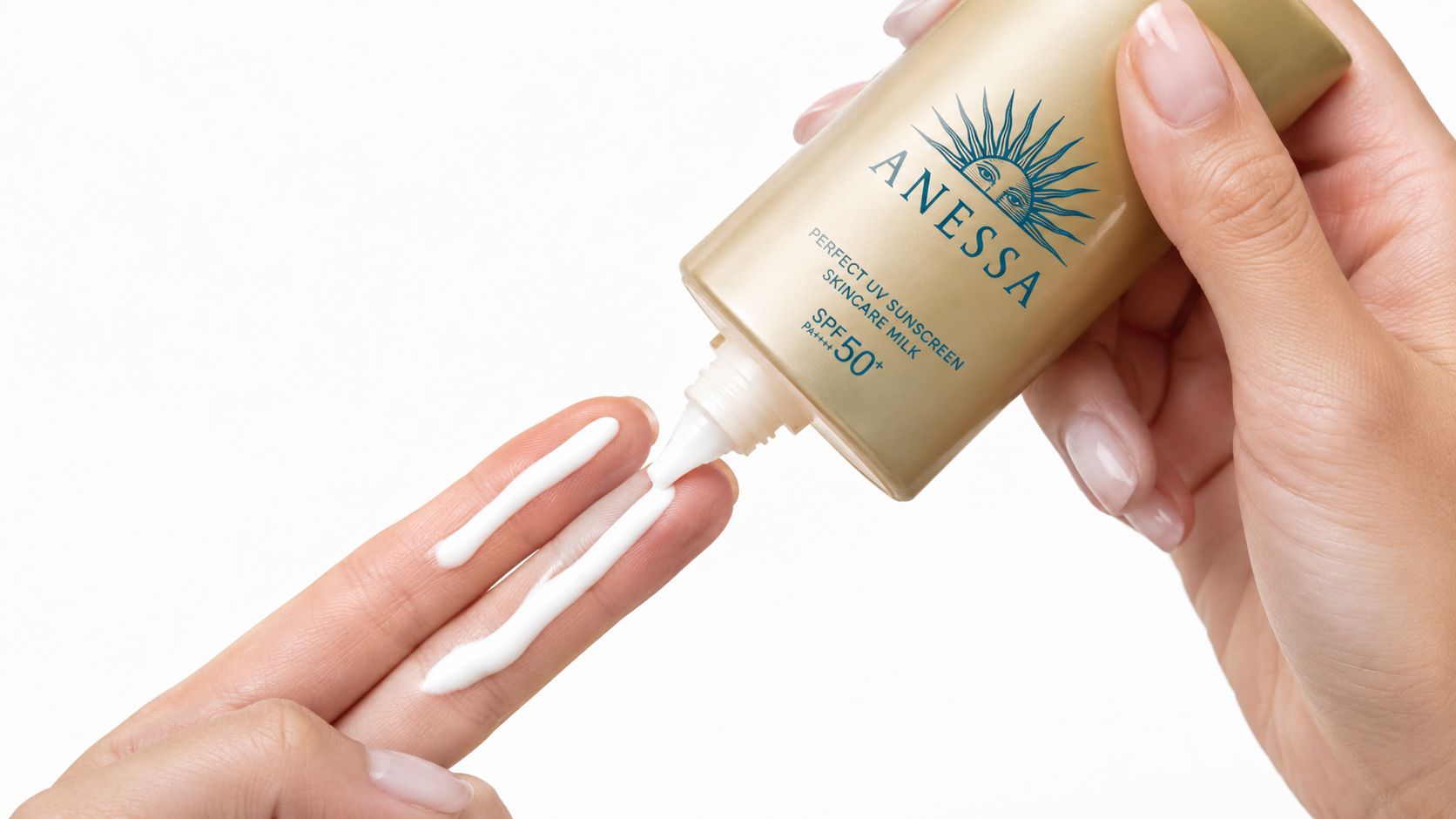
The gel usually settles smoothly under foundation. Press it over the cheeks, forehead, nose, and chin, then give the film a short moment to settle before applying makeup. The milk can work beautifully as a smoothing base, but foundation applied too quickly or rubbed hard can cause pilling and uneven coverage.
Use the format that matches the routine
| Routine | Better starting choice | Application approach |
|---|---|---|
| Office day with foundation | Gel | Apply evenly and let the hydrated film settle |
| Outdoor sport | Milk | Use a complete layer over exposed areas and pay attention to friction |
| Hot, humid travel | Gel for ordinary sightseeing, milk for water activities | Choose according to exposure, not temperature alone |
| Dry indoor winter day | Milk if its finish feels comfortable | Prepare dry areas first with moisturiser |
| Sensitive or recently treated skin | Patch test either product first | Stop if stinging persists and seek professional advice |
Reapplication over makeup requires realism. A thick fresh layer of liquid sunscreen can disturb foundation, so use a sunscreen powder or spray format if that suits your routine, or gently pat a small amount of gel over exposed areas with clean fingertips. Don't drag the product across the face, and don't treat makeup with SPF as a replacement for dedicated sunscreen.
Reapply after significant sun exposure and after towelling off, swimming, or heavy sweating. If the skin feels tight, patchy, or visibly rubbed, assume the film needs attention rather than waiting for the end of the day.
A nightly cleanse matters for both formats. The milk may need a more deliberate cleansing routine because its outdoor-oriented film is designed to stay in place. The gel may feel lighter, but “light” doesn't mean “leave it on overnight.”
For a simple order of application, see this Japanese skincare routine for beginners.
This short demonstration can also help first-time users visualise the amount and spreading motion:
The most important habit is consistency. The gel is often easier to wear every morning, while the milk is more reassuring when the environment is difficult. A product that stays comfortable is more useful than a theoretically excellent sunscreen left unused because the texture feels wrong.
Matching the Format to Your Day and Skin
The clearest answer to Anessa milk vs gel sunscreen comes from the calendar, not a skin-type label. Start with the exposure, then consider finish and makeup. Both formats use the same top-tier Japanese protection label, so the practical differentiator is how well each formula fits the conditions.
| Use Case | Better Format | Why |
|---|---|---|
| Daily commute with short outdoor periods | Gel | Light spreadability makes morning use simple |
| Office day with makeup | Milk or gel, depending on finish | Milk smooths, while gel feels less noticeable |
| Hot and humid commute | Gel | Its lighter, hydrated film may feel less heavy |
| Beach, pool, or hiking | Milk | Stronger resistance makes it the more suitable outdoor choice |
| Outdoor sport with sweat and friction | Milk | The film is designed for more demanding wear |
| Dry winter office day | Milk if comfortable | Its cushioned finish can feel less insubstantial |
| Face and body use during outdoor travel | Milk | More practical when exposure and rubbing are substantial |
| Sensitive or post-treatment skin | Check the exact variant and patch test | The Japanese Mild Milk has separate gentle positioning, but individual tolerance varies |
For an office day with makeup, I wouldn't automatically choose the gel. If you like a smoothing, softly matte base, the milk may make foundation look more polished. If you dislike any perceptible sunscreen layer or prefer a fresher finish, choose the gel and let it settle before makeup.
For a hot, humid commute, the gel is my straightforward recommendation. It feels less demanding and is easier to spread over the face without creating a heavy morning ritual. That recommendation changes immediately if the commute includes prolonged sweating, water, or outdoor sport. In those conditions, take the milk.
For winter or dry indoor air, the milk can be more comfortable for someone who enjoys a cushioned finish, but dry skin still needs proper moisturising underneath. For sensitive or post-treatment skin, neither product should be selected by label alone. Patch test first, and consider the separately positioned Japanese Perfect UV Mild Milk if a gentler milk format is specifically needed. (Japanese Anessa product lineup information)
Gift shoppers face a slightly different decision. If you're choosing without knowing the recipient's exact skin type, the gel is usually the safer crowd-pleaser because its lightweight texture suits more everyday routines. Choose the milk for someone who enjoys makeup, spends time outdoors, travels in warm weather, or prefers a more smoothing and resistant sunscreen film.
For people seeking advice on gentler routines, this guide to Japanese sunscreen for sensitive skin is a useful companion. The short version is simple: choose the gel for daily ease, choose the milk for demanding exposure, and don't confuse identical SPF and PA labels with identical wearing experiences.
Gift Me Japan offers carefully curated Japanese gift sets that bring together beauty, skincare, lifestyle products, and Japanese snacks sourced directly from Japan. Visit Gift Me Japan to explore thoughtful options, including Japanese beauty gifts suited to everyday routines and recipients who appreciate practical, well-chosen products.
Share:
Anessa Sunscreen Guide: Choosing the Right Formula